
Brooks and Capehart on Trump’s low economic approval rating
Clip: 6/19/2026 | 10m 35sVideo has Closed Captions
Brooks and Capehart on Trump’s record-low economic approval rating
David Brooks of The Atlantic and Jonathan Capehart of MS NOW join Amna Nawaz to discuss the week in politics, including the preliminary deal with Iran, President Trump’s record-low approval rating on the economy and some Republicans in Congress breaking with Trump.
Problems playing video? | Closed Captioning Feedback
Problems playing video? | Closed Captioning Feedback
Major corporate funding for the PBS News Hour is provided by BDO, BNSF, Consumer Cellular, American Cruise Lines, and Raymond James. Funding for the PBS NewsHour Weekend is provided by...
Brooks and Capehart on Trump’s low economic approval rating
Clip: 6/19/2026 | 10m 35sVideo has Closed Captions
David Brooks of The Atlantic and Jonathan Capehart of MS NOW join Amna Nawaz to discuss the week in politics, including the preliminary deal with Iran, President Trump’s record-low approval rating on the economy and some Republicans in Congress breaking with Trump.
Problems playing video? | Closed Captioning Feedback
Where to Watch PBS News Hour
PBS News Hour is available to stream on pbs.org and the PBS app.
Providing Support for PBS.org
Learn Moreabout PBS online sponsorshipAMNA NAWAZ: To further discuss the preliminary deal with Iran, President Trump's record low approval rating on the economy and more, we turn now to Brooks and Capehart.
That's "The Atlantic"'s David Brooks and Jonathan Capehart of MS NOW.
Great to see you both.
JONATHAN CAPEHART: Hey, Amna.
DAVID BROOKS: Good to see you.
AMNA NAWAZ: Let's start off with this memorandum of understanding between the U.S.
and Iran that was signed this week.
You have both seen a lot of criticism for how much Iran gets versus the U.S.
out of this deal.
You also may have heard a guest at the top of the show say, look, the war had to come to an end, so that makes it a good deal.
We will see what happens next.
David, is the U.S.
better off today than it was before the war?
DAVID BROOKS: No, it's significantly worse off.
I'm glad the war's over.
I mean, it's good for all of our economy and people stopped dying.
But, listen, in 60 days, Iran may have control of the Straits of Hormuz.
In 60 days, they may be able to restart their nuclear program.
I'm highly dubious they're going to give that up.
And so -- and, plus, they have shown they can stand up to the world's greatest military, survive it, and sort of outsmart it.
And I'm really struck by -- Napoleon has this famous phrase that, when it comes to war, the moral is to the material as 3-1.
Meaning the moral is three times more important than the material.
And how did the United States, with our military, our economy, our alleged power, lose a war to Iran with their military and their alleged power?
And it's because they wanted it more.
And they had leadership that was willing to do whatever it took to win the war.
And we didn't.
We had a president who I don't want to say chicken out, but he wasn't tough enough to fight this war.
And you shouldn't start a war you're not tough enough to fight, especially when their response, closing the strait, is the most obvious thing that we were -- allegedly was seemingly unprepared for.
And so it's a debacle for America.
AMNA NAWAZ: Jonathan, the other point here is, though, what other option does President Trump have, keep fighting the war, let the strait stay closed?
He's under domestic pressure, economic pressure.
Was at least ending the war a good first step to move forward?
JONATHAN CAPEHART: OK, well, first, I -- is the war truly over?
I mean, at least right now, it is as we're talking.
But we don't know.
Look, the president needed an off-ramp.
People have been saying that to him and about him for at least a few weeks now.
So, finally, he's taken the off-ramp.
But I hesitate to call this a deal.
You used the right phrasing, memorandum of understanding.
The hard part comes now in these 60 days, these technical negotiations that the Obama solid painstaking years -- Wendy Sherman, I think she was assistant secretary of state -- basically moved to Switzerland to help negotiate this.
The secretary of energy was involved.
Five other countries were involved in the negotiation of the JCPOA, the Iran nuclear deal.
And President Trump ripped it up.
Does anyone believe he is going to be able to come up with a suitable alternative, from their perspective, in 60 days?
I just do not see it happening.
AMNA NAWAZ: We will see what happens and we continue to follow it.
Meanwhile, we know that war was leading to higher gas prices here, those gas prices a big concern for Americans, whose number one concern remains the economy.
I want to turn to our latest poll numbers here, because our PBS News/NPR/Marist poll has now found that 33 percent of Americans say they approve of the way President Trump is handling the economy.
That is the lowest since Marist began asking the question back in 2019.
The poll also found 78 percent of Americans say high gas prices have affected their household budget.
David, Mr.
Trump is not on the ballot this November, but this is certainly not the message that Republicans wanted to be running on.
How do you look at this?
DAVID BROOKS: Yes, I sort of struck.
One of the things in the NPR/PBS poll was, 45 percent of Americans say they are not going to take a summer vacation, in part because of costs.
DAVID BROOKS: And so that really affects people.
And the American people are really good at understanding when their real wages are going down.
They may see their pay going up, but if it's going up slower than inflation, they know right away.
And they punished Joe Biden for it.
I imagine they're going to punish the Republicans for it.
And this was obviously completely avoidable.
We didn't need to go to this war.
We didn't achieve much at the war.
And we boosted inflation.
And that's not going to come down any time soon.
And gas prices are going to come down, but not any time soon.
And the normal rule in politics is how the how the economy is six months before Election Day determines how people are thinking about it.
I can't do the math, because that's too hard for me, 11 minus six, but that's somewhere around six, five months.
JONATHAN CAPEHART: Five.
Yes, we're within that margin in error.
We're within.
(LAUGHTER) DAVID BROOKS: So, somewhere around now where, people are reflecting on... AMNA NAWAZ: I was told there would be no math in this job.
AMNA NAWAZ: But from Republicans' perspective, how do they manage this?
What is the message now going forward?
DAVID BROOKS: Well, it's super hard to distance yourself from Trump.
You can't really run away.
You can talk about tax cuts and things like that.
It's hard to have an economic message when you don't have an agenda anymore.
And they don't have much of an agenda right now.
And they can try to play the social issues.
I just don't think that's going to fly.
AMNA NAWAZ: Jonathan, Democrats now find themselves in the position they don't often, which is the more trusted party when it comes to the issue of the economy.
Are they making the most of this moment, in your view?
JONATHAN CAPEHART: Yes, I think they are.
And I think they will make even more of it if the situation doesn't change by certainly through the summer, but definitely by the fall.
I think the problem that Republicans have -- this is more of a Republican problem, because they are saddled with an unpopular president who has no message discipline.
So, Susie Wiles, the chief of staff, in some story that I read a couple of weeks ago where she said in a meeting, let Trump be Trump, and everyone else in the administration hammer away at costs and affordability and things like that.
That is impossible, absolutely impossible, in an administration where the president of the United States, particularly this one, commands the attention of the American people at all times.
And what have we seen over all these weeks?
The event might be about affordability, but he will venture off into talking about the ballroom and other things that the American people don't care about.
They want to know how you're going to bring prices down.
And so, as long as the president is doing that and Democrats keep hammering away at affordability, which I think is a part two of what they were doing last year when it came to talking about health care and the danger that was coming to health care, they have been on a pretty -- Democrats have been on a pretty good run of showing the American people that things economically just aren't where they should be.
DAVID BROOKS: One quick thing that could help Republicans is, it used to be you would have swings of like 60 seats, 40 seats, 26 seats.
Those days are long gone because of redistricting.
AMNA NAWAZ: Yes.
DAVID BROOKS: And so now a swing of seven seats to the Democrats would give them majority, but that would be a big deal.
And we're just not in a world where you have these -- a lot of swing districts.
We are in a world where there's another problem that Republicans are dealing with I want to ask you about.
And stay with me as I lay this out, because we have seen tension between President Trump and his party before, but not like this week.
We saw GOP senators openly slam the Iran deal.
But, earlier, the president essentially blindsided Senate Republicans when he basically said that his pick to be director of national intelligence, a man named Jay Clayton, would not show up to his confirmation hearing hours before it was scheduled to start.
And then President Trump demanded that the Republicans attach a stalled election restriction legislation, which doesn't have the votes to pass, to a powerful surveillance bill that needs to be reauthorized the Democrats said they would vote for if Clayton was confirmed.
David, if you are Senate Majority Leader John Thune, what do you do right now?
DAVID BROOKS: I'm trying to think of the last time a president put the kibosh or the slowdown on one of his own nominees.
Usually, it's the other party that tries to slow down nominees.
If you're John Thune, you wake up, you thought, you had something going.
You got rid of this guy Bill Pulte.
You got a responsible adult in there.
AMNA NAWAZ: Bill Pulte is the acting DNI, we should say.
DAVID BROOKS: The acting DNI.
And you got Jay Clayton.
You got a responsible, kind of good nominee.
And then you -- I'm sure he's on social media.
I'm sure he's on TRUTH Social when he gets up in the morning.
And poor John Thune, he's going, oh, no.
And I think it was Senator Kennedy said, who doesn't like John Thune?
It's like not liking a golden retriever.
He's the nicest guy and a very good leader.
And he's doing the best he can in hard circumstances without blowing up at Trump, without totally kowtowing to Trump.
AMNA NAWAZ: Yes.
DAVID BROOKS: And Trump is just making his life miserable.
And I think everybody -- Republican in the Senate sympathizes with Thune right now.
AMNA NAWAZ: Can I just say, making this happen would require that they scrap the filibuster, which Thune has said he would preserve.
Do you see him changing his mind?
(CROSSTALK) DAVID BROOKS: No.
But even if he individually changes his mind, there are a bunch of Republicans who want to keep the filibuster because they value the Senate.
They don't think it should be like the House.
And the filibuster keeps the Senate a separate body, a little more bipartisan.
AMNA NAWAZ: Jonathan, how do you look at this?
JONATHAN CAPEHART: Which part of it?
JONATHAN CAPEHART: I mean, in the case that you laid out, and listening to David, that I scribbled down, can't trust the president.
The president, we have long known, he values loyalty.
But for President Trump, loyalty is a one-way street, which means that you -- if he tells you one day, this is what I want to do, you have to be prepared for the rug to be pulled out from under you.
And John Thune has had the rug pulled out from under him so many times this year that I am looking forward to the moment when Majority Leader Thune just blows his top and stands up for his caucus, for the chamber, and also for the Article I branch of the government.
I mean, they have long been now, I keep saying this, the staffing arm of the executive.
At some point, someone in that Republican majority is going to have to say, enough of this.
And maybe that will come once all the Republican primaries are over and everyone knows where the ground is, and then maybe they will show some independence, but, by then, it might be too late.
AMNA NAWAZ: We will see.
Jonathan Capehart, David Brooks, always great to see you both.
Thank you so much.
DAVID BROOKS: Thank you, Amna.
JONATHAN CAPEHART: Thanks, Amna.
 New
NewArtist celebrates the joy of the Black American experience
Video has Closed Captions
Derrick Adams celebrates the joy of the Black American experience through art (4m 56s)
 New
NewFormer U.S. envoy outlines challenges in Iran negotiations
Video has Closed Captions
Former U.S. envoy outlines challenges in next phase of Iran negotiations (6m 31s)
 New
NewIsrael, Hezbollah fighting threatens U.S.-Iran deal
Video has Closed Captions
Israel and Hezbollah agree to a ceasefire as deadly fighting threatens U.S.-Iran deal (4m 23s)
 New
NewNews Wrap: UK's Starmer faces threat to leadership
Video has Closed Captions
News Wrap: UK's Starmer says he will not 'walk away' amid threat to leadership (6m 1s)
 New
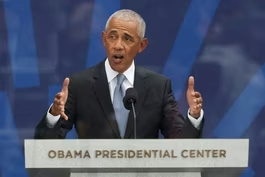
NewObama Center offers a new vision for presidential legacies
Video has Closed Captions
How the Obama Presidential Center offers a new vision for presidential legacies (6m 11s)
 New
NewResearch shows weight-loss drugs may also reduce cancer risk
Video has Closed Captions
Research shows weight-loss drugs may also reduce cancer risk (7m 40s)
 New
NewU.S. advances in World Cup after win against Australia
Video has Closed Captions
U.S. advances to World Cup knockout round after win against Australia (5m 34s)
Providing Support for PBS.org
Learn Moreabout PBS online sponsorship New Episode
- News and Public Affairs

Today's top journalists discuss Washington's current political events and public affairs.

- News and Public Affairs

FRONTLINE is investigative journalism that questions, explains and changes our world.

 New Episode
 New Episode
 New Episode


 New Episode
 New Episode
 New Episode
 New Episode
Support for PBS provided by:
Major corporate funding for the PBS News Hour is provided by BDO, BNSF, Consumer Cellular, American Cruise Lines, and Raymond James. Funding for the PBS NewsHour Weekend is provided by...