
Here and Now
Here & Now for August 7, 2026
Season 2500 Episode 2506 | 26m 45sVideo has Closed Captions
Watch the entire episode of Here & Now for August 7.
Watch the entire episode of Here & Now for August 7.
Problems playing video? | Closed Captioning Feedback
Problems playing video? | Closed Captioning Feedback
Here and Now is a local public television program presented by PBS Wisconsin
Here and Now
Here & Now for August 7, 2026
Season 2500 Episode 2506 | 26m 45sVideo has Closed Captions
Watch the entire episode of Here & Now for August 7.
Problems playing video? | Closed Captioning Feedback
Where to Watch Here and Now
Here and Now is available to stream on pbs.org and the PBS app.
Providing Support for PBS.org
Learn Moreabout PBS online sponsorshipPBS Wisconsin Original production.
>> Madison officials cleared the memorial site, where a police officer shot and killed a man in.
Candidates competing in the primary for governor make their final bids to land on the November ballot.
[MUSIC] Good evening.
I'm Zac Schultz, filling in for Frederica Freyberg tonight on here.
And now, a final look at the candidates running for governor ahead of Tuesday's partisan primary election.
And we'll examine the limits of First Amendment rights as Madison police shut down the protest encampment and the Lac du Flambeau band asserting sovereignty around their reservation leads to federal lawsuits.
It's "Here& Now" for August 7th.
>> Funding for Here and Now is provided by the Focus Fund for Journalism and Friends of PBS Wisconsin.
>> It was just over a year ago that Governor Tony Evers announced he would not seek a third term in office.
The number of candidates seeking to replace him as the Democratic nominee for governor eventually surged to seven.
But today there are just four left, and after Tuesday night, the party will seek to unite behind the winner against the Republican nominee, Tom Tiffany.
>> You know, I think right now we are truly in a movement moment.
>> On a Wednesday night in July.
There's a packed house at the headquarters of the Democratic Party of Ozaukee County.
It's standing room only to hear from Francesca Hong, the frontrunner in the Democratic primary for governor.
>> I may not be the most polished candidate.
I know that there are questions about executive experience and leadership.
>> A democratic socialist, Hong has served three terms in the state Assembly.
Not the typical resume for a gubernatorial candidate.
>> I would say one of the most powerful messages that I carry with me in knowing that maybe this is time for a leader like me.
>> Hong has consistently polled well ahead of the rest of the field, and her political movement is built on bringing new people into the voting booth.
>> It's imperative that we grow a coalition and the electorate for Democrats to win power and maintain power.
We have to make sure that our coalition is multigenerational, multi-faith and with representing zip codes from all across the state.
It's exciting to hear folks have their plan to vote, and it's their first time to vote.
>> Democracy can be messy, and.
>> David Crowley is now polling second.
Just a few weeks after he was out of the race altogether.
He dropped out in early July and endorsed Sara Rodriguez, but then got back in after her campaign blew up a week later, this time with the endorsement of Tony Evers.
The in and out maneuver is not recommended for candidates, but Crowley probably got more attention than if he was in the race the whole time.
>> Hindsight is always 2020, right?
And so, you know, trying to, you know, wonder what would have happened or how things would have unfolded if I was in this race.
We don't know.
I can't look into a crystal ball, but we did see a resurgence of energy.
I mean, I think we had more people at our relaunch party that was at our launch party.
>> Campaigns change in very short order.
>> Joel Brennan and Kelda Roys are the last two Democrats in the race.
They have consistently pulled in the low single digits and share the idea that if more people knew their names, they'd have more support.
>> My challenge from the beginning has been that I am just not as well known as other candidates, not as well known in some parts of the state.
I think when people have seen and heard from me, they understand my experience, the work that I've done, the vision that I have, like I win over lots of those people.
>> We need a candidate at the top of the ticket who will not only beat Tom Tiffany, but help us deliver a Democratic Assembly and Senate.
And most importantly, we need somebody who's actually capable of doing the job of governing.
>> Are we going to stop big government socialism right here in Wisconsin?
Yeah.
>> Waiting on the other side of the primary is Tom Tiffany, a congressman from northern Wisconsin who is largely unopposed in the Republican primary.
>> My mom quilts.
[MUSIC] >> I've been a dam tender, a boat captain and a girl dad with perfect attendance at 20 nutcrackers.
[MUSIC] >> Tiffany's record in Congress and the Wisconsin legislature before that shows he's a far right conservative, but he's spent millions introducing himself to the state as a folksy everyman.
>> Tom, you know mom's gonna hold you to it.
[MUSIC] >> I wouldn't have it any other way.
Yeah.
I mean, it was one of the goals from the start was to make sure that people got to meet me on my own terms.
>> Democrats have spent their millions on their own ads, but aren't worried.
Tiffany has gained too much of an advantage.
>> Tom Tiffany has been the frontrunner presumptive nominee for months.
To still be doing intro ads is a little bit embarrassing.
>> Listen, I like old Fashioneds.
I've got four daughters and a son.
I like going to The Nutcracker with them.
That is not what qualifies me to be governor.
>> We don't have to redefine.
We just have to make sure that people know who he is.
Always been.
And like my grandma used to say, you know, when someone shows you who they are the first time, you have to believe them.
>> Whoever wins this primary is going to come out with wind at our back with momentum, and then we'll be the time where Tom Tiffany can't just look over his shoulder and talk about his mother.
He's going to have to look over his shoulder and talk about Donald Trump.
>> After the primary, Tiffany's ads will have an opponent to attack by name.
And for his part, he says he's not worried about which Democrat he faces.
>> There really isn't a dime's worth of difference between the candidates.
I mean, they're very similar, and whoever comes out of the primary is going to be advocating for the same stuff.
>> Reporting from Muskego.
I'm Zac Schultz for Here and now.
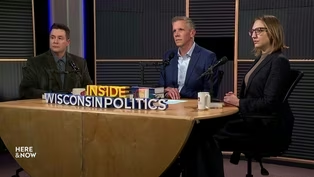
In this week's Inside Wisconsin politics had more to say on the two leading candidates.
I'm joined by NPR's Shawn Johnson, Anya van Wagtendonk and Rich Kremer.
>> It seems like just a few weeks ago on this show, we were all kind of wondering where all these candidates in this big primary fit.
What were their political lanes?
>> Well, I think you have the context of the national political mood for primary voters, which are Democrats that are mainly angry at Donald Trump and his administration there.
If you look at it in that frame, the establishment's the bad guy.
The establishment is national Democrats who haven't done enough to stand up to Trump.
So tapping into those voters meant you couldn't be the establishment because then you were on the side of inertia.
So Francesca Hong clearly moved to the left.
She was going to fight, fight, fight.
And a lot of the other Democrats in this race were trying to outflank her, and they just could not.
has a particularly kind of interesting personal really sort of impoverished, challenged background in Milwaukee.
And so up until, you know, he dropped out the first time in this race, he was kind of described as potentially not electable because statewide, there's a there's sometimes, you know, negative feelings about Milwaukee.
There is, you know, always the racial element of the fact that there's never been a Black man elected to statewide office in Wisconsin.
So there were all these questions about him.
Then he comes back with the endorsement of Tony Evers, and all of a sudden he's described as the establishment.
It's a needle of I'm a viable candidate, but I will also stand up to the things that you're angry about.
>> Crowley raised more than twice as much money during the month of July.
He raised $776,000 thereabout, and Hong brought in around $339,000.
So that is a big sign that, at least in terms of money, Crowley's campaign is getting some backing.
And the other sign that caught my attention was Governor Tony Evers, you know, who endorsed Crowley's campaign, which is definitely being framed as an alternative to Francesca Hong.
He also gave $20,000 from his from Evers campaign account to Crowley's campaign account.
That's not a lot of money, but it could be a signal to Evers donors, Evers supporters that I'm not just saying I support this.
I'm putting my money behind it.
>> Francesca Hong is running a really unique, strange race.
She has not raised as much money, but it doesn't seem to matter.
She's making sort of headlines on her own, sort of organically rather than through these paid ways.
And then all these other candidates are just trying to kind of trying to to catch up.
>> And she's not putting herself on TV, but other people are.
You've had these Republican groups consistently putting her in TV ads, calling her liberal ahead of this primary.
>> She has spent $0 on television, which is just unheard of in any type of serious race.
And she's not running just a serious race.
She's running the leading race.
She's doing some, you know, digital media and things like this.
But a lot of her campaign is very grassroots, very kind of door to door.
And so you're right, when we see if you see her face on your TV or on your your YouTube, it is because these Republican groups are paying for ads trying to get her over the finish line because they think she's beatable.
But meanwhile, she kind of says, you know, thanks for for calling attention to my policies.
>> You can get the full episode of Inside Wisconsin Politics wherever you get your podcasts.
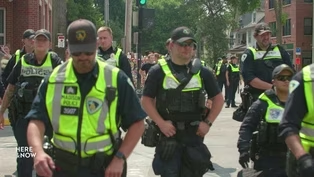
Earlier this week, Madison police in riot gear cleared out a protest encampment at the intersection where an officer shot and killed Corey Ruiz on July 22nd.
For at least two nights, protesters responded by throwing rocks and setting fires in the street.
More than two dozen people have been arrested.
In a written statement, the Ruiz family denounced any affiliation with the encampment, calling for people to be peaceful.
Here and now, reporter Murv Seymour was on the scene and brings us this report.
>> I personally do not plan on leaving this space at all.
>> Going into the 13th day of this protest.
The week begins with tension and a seeming clock ticking at the corners of Baldwin and Williamson streets.
Just how long could.
And would this intersection where Corey Ruiz was shot and killed by a Madison police officer remain closed?
>> I've been here since the 22nd.
>> Some businesses stuck in the past still shut down as city officials and protesters work to hash out a resolution that comforts both sides.
Some community members demand a permanent memorial to honor Corey Ruiz.
City officials say they're open to that, but want an end to the encampment.
>> And now the grief has turned into anger.
Now, because they're not moving swiftly enough.
>> That's what community activist Jackie Morris says about police and the city's investigation.
He and others continue to demand that the unidentified officer who pulled the trigger is arrested and charged.
>> As a community, what are we doing here?
>> Azrael JD, who goes by the name spawn, wants to see more than that.
>> The perfect situation would be a complete end to policing as we know it, at least in the city of Madison.
Policing should lie in the hands of the community.
>> I'm sure if they arrested him right now, at this minute, all this would go away with blink of an eye.
week, all four corners leading to the scene still cut off by homemade blockades set up by protesters made of cars, RVs, debris and at this section, a bed of nails.
>> What's his name?
>> A day before the two week mark of this controversial shooting, in what seems like a blink of an eye during a pre-dawn raid, a swarm of nearly 50 law enforcement officers sweep in, clearing out with force what couldn't be cleared out with patience, compromise or negotiations.
>> By the time that I got over here on all four of these corners, there were dozens of cops out here, dozens on every single corner.
And the mayor has been like, oh, it's dangerous.
The businesses are against them.
The neighbors are against them.
It's not sanitary.
The food isn't safe.
But they always do that because they will always paint out community protecting each other.
>> Can you guys move off the spot?
I did.
>> Kern Latinos.
>> Criticism over policing in Madison makes its way all the way to leaders at City Hall.
>> How are we supposed to build trust with this?
How do you come back from this?
>> This week's virtual Common Council meeting lasts more than seven hours.
>> But my neighbors, the people I care about, they are being terrorized every day by these police officers.
>> Three minutes at a time.
Almost 400 people registered to speak, most in support of more trauma inspired policing.
>> People need to have more of a grieving time for all this.
funding for.
>> Oversight without resources is not oversight.
>> In her first briefing with reporters flanked by the police chief and other city leaders, the mayor admits there's work to be done to better relationships between police and the people they're sworn to protect.
>> I still believe that we will do better working together than causing more harm and destruction.
I very much hope that our community can come together, start listening to each other across difference.
Acknowledge some of the deep structural issues in our society and focus on how we move forward.
>> I've identified some areas that I think we're going to make immediate progress on, hopefully in immediate steps, to do some restructuring to help us get there.
But that takes time.
And the mayor's point, it's it's near impossible to do it when you're in the middle of a crisis.
>> For most of the week, traffic flows through this traumatized community pretty much like normal.
But the sense of permanent peace and normalcy in and around this intersection remains to be seen.
>> The community needs some kind of closure, and we need to be able to trust the police, the ones who protect and serve us instead of the community against the police, the police against community.
>> And that's something both sides can agree on.
Reporting from Madison.
I'm Murv Seymour for here and Now.
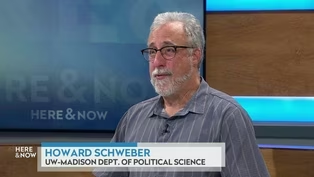
>> The First Amendment to the Constitution protects our freedom of speech and the freedom to assembly, including to protest.
But what are the limits to those rights?
For that, we welcome.
UW-Madison political science professor Emeritus Howard Schweber.
Thanks for your time today.
>> Well, thank you for having me.
initially took over the intersection where a man was shot and killed by police, they were assemble.
Were they still within their legal constitutional rights to be in that public space?
>> No.
Or to put it differently, not necessarily.
So let's back up a step.
The way these kind of rules, the way rights in general we talk about them is not in terms of you have the right to do X, but in terms, can the government stop you from doing X?
It's always a negative constraint on what the government may do with the implication that anything that's not left free to undertake.
So the rules are the government is perfectly free to make what are called content neutral time, place and manner regulations.
And these are things like don't use loudspeakers at night.
Don't camp overnight in a park.
Those are actual old cases.
So there's no question that cities and states have the authority to make those rules, so long as they're content neutral.
There are two complicating factors.
One is when a city or state makes these rules, they have to be as little restrictive of expression as is possible.
The other complicating factor is whatever rules are adopted, there has to be adequate alternative avenues for expression.
So those are the broad general principles.
And having said all that, setting up an encampment that blocks traffic and close businesses.
Yeah, that's very clearly something that is not protected by the First Amendment and something the government is perfectly free to put an end to.
>> So what happens then when a city doesn't enforce those rules?
>> Right.
So and of course, you know, I think we all recognize that the broader context of this goes back to Black Lives Matter and the pro-Palestinian encampments that got so much attention during the 2024 presidential election, in the first months of President Trump's term, we've seen a growth, a considerable growth in the last few years of protests and protests in the form of encampment.
It's just become a style of protesting that's become popular.
And one of the problems that raises is precisely the problem you just mentioned, which is and you're exactly right to ask that question what happens if the application of the rules I'm talking about the state is inconsistent?
What if some encampments allowed and others, you know, are taken down?
And that was precisely the claim that was made in the case of the of the pro-Palestinian encampments and pro-Israel legislators and citizens who objected to the way they were being treated.
The claim was it was inconsistent.
These encampments were being allowed.
These students were being allowed were being allowed, being permitted to be disruptive in a way that other student protesters had not been.
So a city or state can run into trouble by showing favoritism as well as disfavor.
The flip side is whether we're talking about a city or a university, or a state government, or any police force.
Discretion is always part of the job description.
Using your judgment, deciding when to step in, deciding how much leeway to allow.
And that always opens the possibility of someone claiming you're being inconsistent.
>> So we've talked about the word encampment coming around in protest movements more.
And, you know, we can go back 15 years to the act ten protests where the capital was occupied for more than a month.
There were protest zones within there where the protesters themselves prevented media from accessing certain halls, legislators from getting to their offices.
That was negotiated in terms of how people would exit the capital, the preservation of materials.
There were very few arrests down to the last handful of people brought out, obviously, the Palestinian protest encampment on UW-Madison required police intervention.
This one did.
>> Well, we should be clear on this.
The Palestinian protest in Kamala Madison was tolerated for a considerable period of time.
The university and, you know, this is the bind that they're in.
They tried to do this with a gentle hand.
They tried to exercise discretion to maximize the ability of students to express themselves.
They tried to find a balance between allowing this, this expressive activity to go forward while preventing disruption.
But that becomes the problem.
So take Acton, for example, many conservatives who oppose the protests who supported Governor Walker were deeply upset.
Why are the police not throwing these people out?
Why are they letting these people occupy our Capitol building and prevent the business of the government from going forward?
Would they do the same if this were the Ku Klux Klan?
And again, they're not wrong.
The answer, I hope, is no.
So this just gets back to the point I was making earlier.
There is a history of encampments and takeovers.
In recent years, governments have been wrestling with them, and the politics around those government responses has been so amplified and made so partizan and fraught because of the way Trump treated those issues when he ran for president in 2024, that now, you know, all the cities, universities, states are on tenterhooks trying to way to proceed.
And the error on the side of caution is intervening and moving the encampments out rather than being unduly tolerant.
>> So kind of put a bow on this in terms of the First Amendment and protesters, well, it's my First Amendment rights.
What is the great confusion there that comes within the bounds of your rights versus someone else's rights?
version is you have a right to protest up to the point where you're disrupting other people's ability to go about their day.
This is a simplistic, simplistic version, of course, but it's not far off if you block streets, if you block sidewalks, if you block access to businesses, if you block people's ability to get out of their home, if you disrupt the operation of classrooms, for example, none of those is protected by the First Amendment.
The First right to express yourself in ways that are peaceful and discursive.
There simply is no protection for engaging in, well, civil disobedience.
And the reason we call it civil disobedience is that when you do that, when you deliberately march into a racially segregated lunch counter and integrate it, right, you acknowledge you risk being arrested and suffering the punishment.
That's part of the whole civil disobedience paradigm.
And it's an honorable it can be a very honorable thing.
But there is not a First Amendment right to engage in acts that would otherwise be crimes.
>> All right, Professor Schweber, thanks for your time today.
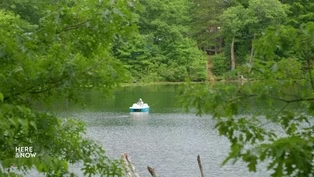
>> Another battle between property owners in the Lac du Flambeau band of Lake Superior Chippewa is in court.
The tribe recently declared non-Native peoples could not fish for walleye and muskie in lakes within tribal territory.
And they're now facing a federal lawsuit.
“Here& Now” reporter Erica Ayisi traveled to the Northwoods to hear how tribal members feel about their sovereignty being challenged in court.
This report is in collaboration with Eich T, formerly Indian Country, today.
>> I feel strongly that everyone needs to take care of what we have on earth.
That means our water, our land, and everyone's well-being.
>> Bagwajikwe Madosh is a citizen of the Lac du Flambeau band of Lake Superior Chippewa Indians, and she says she believes in preserving Ojibwe traditions, which the Lac du Flambeau tribe is defending in federal court.
>> Let us do what we know best replenish our lakes, keep our grounds clean, our forests long.
>> Interlaken Lake is one of 19 lakes within the Lac du Flambeau Reservation that a federal judge temporarily blocked the tribe from, banning nonmembers from fishing walleye and muskellunge in fish.
>> We replenish the fish, we replenish, we take.
>> DOGE says their fish hatchery helps to maintain their stock, but says there's concern about the fish population.
>> It's not what you use it and then go on with life without knowing what's going to come next.
>> The state of Wisconsin sued the tribe for blocking nonmembers from fishing in certain lakes.
Tribal President John Johnson said the fish population is declining but needed to feed their 4000 tribal members.
change, a lot of it's logging structure, infrastructure, everything that goes on in our territory.
We're here to protect it.
>> Madhosh says.
There's overfishing on their lakes and rivers.
>> We need to all limit what we take, you know, and many people are taking what many people can have as well.
>> Flambeau Lake is also mentioned in the lawsuit against the tribe.
>> Walz, which is Lake of the Flaming Torches.
>> Adrian King grew up here and has seen new neighbors over the years.
>> A lot of these are non-native houses, as far as I know.
>> He says he supports the tribe in responding to a second federal lawsuit involving the tribe, this one filed by the White Sand Lake Association, a group of non-Native homeowners who are suing the tribe for access to use a boat launch on a private property on the shoreline of White Sand Lake that's within the reservation.
>> At least, are experimenting, are flexing their sovereignty a little bit more.
>> The tribe says the lake is threatened by documented environmental concerns, including the presence of Eurasian watermilfoil, an invasive species under Wisconsin law, saying it threatens their cultural resources along the shoreline.
>> However, the information and data came from whether it was our own or the state's, we, we.
We pay attention to that.
>> According to the lawsuit, the association is asking the Federal court to decide whether a tribal government may regulate the activities of nonmembers on a fee.
Simple, privately owned land and navigable waters in the state of Wisconsin.
Tory Dolan, assistant professor of law at the University of Wisconsin and citizen of the Choctaw Nation of Oklahoma, says the United States recognizes Indian tribes as sovereign nations who have the right to govern themselves, their members, and their territories.
>> It means that they're exercising their ability to have a say over what happens in their territory and in their community.
>> When we talk about, they can govern themselves.
What does that mean for the communities that are around them?
>> Generally, just being in tribal territory, you are going to interact with tribal law in some capacity.
>> Dolan says the Lac du Flambeau reservation is checkerboarded with non-tribal members purchasing property there because of the Dawes Act or General Allotment Act of 1887.
>> Congress created the Dawes Act, which authorized Indian agents to go into tribal communities, parcel out the communal land, sell the surplus.
>> In a different federal case.
Last year, a judge sided with non-tribal homeowners in a dispute over access to four tribal roads that led to private properties on the Lac du Flambeau reservation.
>> The Bureau of Indian Affairs approved these easements, and once they expired, the tribe sought to assert their property rights by closing these roads.
was motivated by a belief that Native American Indians would die out, assimilate or be indistinguishable from non-Indian populations.
>> That's why we have so many legal and political issues today, because they really didn't expect tribes and tribal people to endure.
>> Dolan says.
She believes it's important.
>> Their ability to enforce their own laws means their ability to continue to exist as a people, to continue to exist in their territory and to protect the area.
>> King says.
In times like these, the different tribes in Wisconsin come together.
>> They feel a part of the tribe or a tribe, and they want to do their part to protect it.
>> We as a people want to keep our earth as clean as possible.
>> Meadows says the pending federal lawsuits involving the Lac du Flambeau are about keeping their tribal sovereignty.
>> That's the main one that we need to keep for ourselves.
>> And maintaining their culture.
>> And for our children for times coming in.
>> Lac du Flambeau.
I'm Eric Ayisi for Here and Now and I see T.
>> For more on this and other issues facing Wisconsin, visit our website at PBS wisconsin.org and then click on the news tab.
That is our program for tonight.
Frederica Freyberg will be back next week.
I'm Zac Schultz have a great weekend.
[MUSIC] >> Funding for "Here& Now" is provided by the Focus Fund for Journalism and friends of PBS Wisconsin.
 New
NewHere & Now opening for August 7, 2026
Video has Closed Captions
Clip: S2500 Ep2506 | 58s | The introduction to the August 7, 2026 episode of Here & Now. (58s)
 New
NewHoward Schweber on First Amendment rights and Encampments
Video has Closed Captions
Clip: S2500 Ep2506 | 10m 37s | Howard Schweber on protest encampments in Madison and freedom of speech and assembly. (10m 37s)
 New
NewInside Wisconsin Politics: The 2026 Primary Election Arrives
Video has Closed Captions
Clip: S2500 Ep2506 | 3m 21s | Inside Wisconsin Politics on how Democratic primary campaigns for governor have played out. (3m 21s)
 New
NewTribal Sovereignty is at Issue in Lac du Flambeau's Lawsuits
Video has Closed Captions
Clip: S2500 Ep2506 | 6m 6s | Asserting sovereignty is key to the Lac du Flambeau Band's moves to limit fishing access. (6m 6s)
 New
NewWhat's Next for Madison After the Ruiz Shooting Encampment?
Video has Closed Captions
Clip: S2500 Ep2506 | 4m 43s | The city of Madison cleared a protest encampment 13 days after Corey Ruiz was killed. (4m 43s)
 New
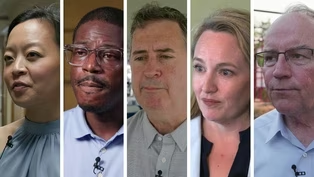
NewWisconsin's 2026 Primary for Governor Hits the Home Stretch
Video has Closed Captions
Clip: S2500 Ep2506 | 4m 52s | Four Democratic candidates remain in the 2026 primary for governor of Wisconsin. (4m 52s)
Providing Support for PBS.org
Learn Moreabout PBS online sponsorship New Episode
- News and Public Affairs

Top journalists deliver compelling original analysis of the hour's headlines.
 New Episode
- News and Public Affairs

Today's top journalists discuss Washington's current political events and public affairs.
 New Episode
 New Episode
 New Episode
 New Episode
 New Episode


 New Episode
 New Episode
Support for PBS provided by:
Here and Now is a local public television program presented by PBS Wisconsin