
July 8, 2026 - PBS News Hour full episode
7/8/2026 | 56m 45sVideo has Closed Captions
July 8, 2026 - PBS News Hour full episode
July 8, 2026 - PBS News Hour full episode
Problems playing video? | Closed Captioning Feedback
Problems playing video? | Closed Captioning Feedback
Major corporate funding for the PBS News Hour is provided by BDO, BNSF, Consumer Cellular, American Cruise Lines, and Raymond James. Funding for the PBS NewsHour Weekend is provided by...
July 8, 2026 - PBS News Hour full episode
7/8/2026 | 56m 45sVideo has Closed Captions
July 8, 2026 - PBS News Hour full episode
Problems playing video? | Closed Captioning Feedback
Where to Watch PBS News Hour
PBS News Hour is available to stream on pbs.org and the PBS app.
Providing Support for PBS.org
Learn Moreabout PBS online sponsorshipGEOFF BENNETT: Good evening.
I'm Geoff Bennett.
AMNA NAWAZ: And I'm Amna Nawaz.
On the "NewsHour" tonight: DONALD TRUMP, President of the United States: I don't want to deal with them anymore.
They're scum.
AMNA NAWAZ: President Trump declares the cease-fire with Iran over, as the U.S.
launches a second day of strikes, prompting a spike in gas prices.
GEOFF BENNETT: An ICE agent kills a Mexican national in Houston in the latest deadly interaction with immigration enforcement.
AMNA NAWAZ: And we examine how the so-called Great American State Fair politicized the nation's 250th birthday.
HANNAH TURER, Washington, D.C., Resident: There's definitely state booths also that just have Trump's face plastered everywhere.
So it's not even a celebration of the country.
KARL MINACAPELLI, Maryland Resident: I was around in '76 for the bicentennial.
They didn't have anything this grand.
I think this is pretty cool.
(BREAK) GEOFF BENNETT: Welcome to the "News Hour."
Tonight, the U.S.
is carrying out a second straight night of strikes on Iran.
The U.S.
military says it launched attacks to degrade Iran's ability to threaten freedom of navigation in the Strait of Hormuz.
AMNA NAWAZ: Iranian media is reporting the sounds of explosions along the coast of the strait and the Gulf of Oman.
President Trump telegraphed these strikes earlier today at the NATO summit in Ankara, where Nick Schifrin is reporting for us once again.
So, Nick, what can you tell us about these strikes?
NICK SCHIFRIN: Amna, tonight, President Trump says that he is bombing Iran in -- quote -- "retribution" for attacks by Iran on ships, -- for targeting ships transiting through the Strait of Hormuz.
But he also said earlier today that he did not want the war to restart.
Now, tonight, a U.S.
official tells me that they are targeting Iranian radar, missiles and air defense and other Islamic Revolutionary Guard Corps targets.
Now, Iran has tried to continue to have a de facto control over the Strait of Hormuz by attacking these ships that are not asking for Iranian permission, not using an Iranian corridor beforehand.
And, in turn, the U.S.
military is trying to use these strikes to convince Iran to stop doing that.
Now, as you said, President Trump did telegraph these strikes earlier today at the NATO conference here in Ankara.
He's also whiplashed between saying he wanted the cease-fire -- he's declaring the cease-fire to be dead, but then also saying that he didn't want any kind of long-term conflict with Iran.
And that -- zigzags really define his comments not only about Iran, but also about U.S.'
NATO allies.
Today, in Turkey, surrounded by allies he'd spent days and months insulting, threatening, and scolding, President Trump declared they were once again in love.
DONALD TRUMP, President of the United States: I just want to say there was tremendous love in that room.
NICK SCHIFRIN: Today was typical Trump.
DONALD TRUMP: Spain is a wasted cause.
We don't want to do any trade business with Spain anymore, by the way.
NICK SCHIFRIN: Starting with snubs and threats impossible to impose and reopening an old wound.
DONALD TRUMP: Greenland is very important for the United States, but it's not important for Denmark.
NICK SCHIFRIN: That drew this response from the Danish prime minister: METTE FREDERIKSEN, Prime Minister of Denmark: We are ready to defend every inch of NATO, including our own territory.
NICK SCHIFRIN: But the day ended with praise.
DONALD TRUMP: Very smart people, and they have a lot of good in their heart, not evil, good.
And they're doing a great job for their country.
NICK SCHIFRIN: Today's whiplash wasn't only reserved for NATO.
MAN: Whoa.
NICK SCHIFRIN: On Iran, after last night's American strikes that one U.S.
official called turning up the volume, this morning, President Trump declared the cease-fire dead.
DONALD TRUMP: I think it's over.
I don't want to deal with them anymore.
There's scum.
You know what scum is?
They're scum.
They're sick people.
There's something wrong with them.
They're cuckoo.
As far as I'm concerned, it's over.
NICK SCHIFRIN: He ended the summit suggesting tonight's strikes are not intended to restart the war.
DONALD TRUMP: I think it's going to go very quickly.
They hit a couple of ships.
And so we hit them much harder.
When they hit, we hit 10 times harder.
We hit much harder than they do.
Anything that happens, it's going to happen very fast.
We're not looking for long term.
NICK SCHIFRIN: But Iran is trying to create long-term leverage.
Earlier today, it launched missiles at U.S.
bases, sparking air raid sirens in Kuwait, which hosts U.S.
troops, and yesterday attacking three tankers in the Strait of Hormuz, including one that signaled mayday.
Iran's chief negotiator today warned: "The era of bullying and extortion is over.
It leads nowhere.
We don't fold."
VOLODYMYR ZELENSKYY, Ukrainian President: I think that now initiative moved to our hands.
NICK SCHIFRIN: Ukraine hasn't folded either.
And if there is any leader who's felt the president's whiplash, it's Ukrainian President Volodymyr Zelenskyy.
DONALD TRUMP: We have developed a good relationship.
It's hard to believe, right, from the Oval Office to now.
You're gambling with World War III.
NICK SCHIFRIN: From last February's Oval Office train wreck to an October demand the war end no matter the cost to Ukraine.
DONALD TRUMP: They should stop right now at the battle lines.
Go home, stop killing people, and be done.
NICK SCHIFRIN: But, today, President Trump praised Ukraine's long-range attacks on Russian energy targets.
DONALD TRUMP: It's an escalation.
But it's also an escalation that can help lead to an end.
NICK SCHIFRIN: And today, for the first time, President Trump vowed to help Ukraine build its own Patriot air defense missiles.
DONALD TRUMP: We're going to give a license to you to make Patriots.
That's pretty cool, right?
This way, you can't complain that we're not giving them enough.
I would say, make them yourself.
We haven't informed the company of that yet, but that will -- that will work out all right.
NICK SCHIFRIN: It's all going to work out, perhaps a description of some of President Trump's approaches to foreign policy.
We don't know how Iran will work out tonight, but multiple officials telling me that NATO at least is in a better place than they thought it was just yesterday.
AMNA NAWAZ: Nick, from your reporting on the ground, how did the president's public criticisms of NATO compare to what you learned he's saying in private?
NICK SCHIFRIN: I think it's a key question, Amna, because what he is saying in private, I'm told, is very different than what he is saying in public.
And I talked to multiple people who attended the NAC meeting tonight, the NATO leaders meeting here in Ankara, and they all said that he was very respectful.
He was patient.
He listened to everyone in the room.
And one official told me that, at the end of the meeting, he turned to the whole group and said what we heard him say in public: "I feel a lot of love in this room tonight."
And perhaps that what is leading to some of the comments that I and others are really getting from leaders who were in that room.
Baiba Braze, the Latvian foreign minister, I interviewed her earlier today.
She said there was a consensus in the room about more European spending.
And we heard from the German chancellor, Friedrich Merz, earlier today, who called it an important step toward a more European NATO, and that President Trump -- quote -- "showed great empathy even to smaller NATO countries."
But, look, President Trump's comments do have an impact.
A senior European official told me that all of the comments about Greenland, for example, the U.S.
needing to control Greenland, would make some kind of U.S.-Greenland-Denmark deal less likely.
And there's still concern about a U.S.
transition or drawdown out of Europe, trying to get Europe to defend itself conventionally, that Europe will not be able to backfill what the U.S.
is going to withdraw from Europe.
Take a listen to Belgium's defense minister, Theo Francken.
THEO FRANCKEN, Belgian Defense Minister: I think that's there is a major concern about the security architecture of Europe, of NATO, our alliance, the strength of our alliance.
We cannot be divided.
We should -- we have to show unity.
United we stand.
Divided we fall.
And this is a major concern.
And that remains to be the major points on the political level.
NICK SCHIFRIN: And just to make sure, concern that, what, that the United States will leave Europe vulnerable?
THEO FRANCKEN: No, that's there's on both sides of the Atlantic so much miscomprehension that we're not even talking of having dialogue and that we're not listening one to each other.
NICK SCHIFRIN: You don't think there's dialogue and there's no listening right now?
THEO FRANCKEN: There's a lot of dialogue, but there's also a lot of frustration from both sides of the Atlantic.
NICK SCHIFRIN: That frustration, Francken did say that Secretary-General Mark Rutte was trying to reduce the frustration in the room, trying to coordinate the U.S.
drawdown from Europe, so that the U.S.
coordinate it with allies.
But, Amna, for Minister Francken to admit that level of frustration is really telling and that the president's words do go a long way at reducing the unity of NATO, regardless of whether they had a good meeting at a senior level tonight.
AMNA NAWAZ: All right, that is Nick Schifrin reporting from the NATO summit in Ankara, Turkey.
Nick, thank you.
GEOFF BENNETT: For perspective, we turn now to Ivo Daalder.
He was U.S.
ambassador to NATO during the Obama administration and is now a senior fellow at Harvard University's Belfer Center.
It's always great to have you with us.
Before we get to the NATO summit, I want to ask you about Iran, because the administration says these latest strikes are a direct response to Iran's attacks on commercial vessels in the Strait of Hormuz.
Was a military response inevitable, in your view?
What options did the president have, short of renewed strikes?
IVO DAALDER, Former U.S.
Ambassador to NATO: No, I think some kind of military action was pretty inevitable.
I think the fundamental problem isn't the strikes left or right.
We have had this now since the cease-fire was started back in April.
The fundamental problem is that we are somehow deluding ourselves that, because we signed a memorandum with Iran, we agree on the fundamentals.
And we don't.
The fundamental reality is, is that Iran wants and will insist on having control over who gets access to the strait.
And we want freedom of navigation, which is what we have had in this part of the world until the day the war started.
And that's a fundamental difference that the first point in the memorandum sort of papered over.
It was always clear that the Iranians had a different view then than we did on what would happen to the strait.
And that's now playing out.
And, unfortunately it's playing out with fire across various parts of the strait.
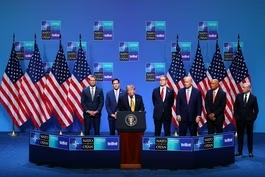
GEOFF BENNETT: Well, this conflict with Iran loomed over the NATO summit, as you well know.
As Nick reported, President Trump left the summit saying there was a lot of unity, but he also criticized allies over Iran, over defense spending, over his own desire to acquire Greenland.
What did this summit actually reveal about the state of the alliance?
IVO DAALDER: Well, it revealed that things are not as bad as they could be, but they're certainly not in a great state.
I think the leaders leaving Ankara today are glad to know that they're probably not going to have another summit any time soon.
There was supposed to be one next year.
They have now been silent about whether that will in fact occur.
The reality is that the 32 leaders came with their large entourages to Ankara, and all they tried to do is to make sure that nothing bad happened, that nothing would blow up, that we could manage the president of the United States in a way that he wouldn't withdraw from NATO or do anything else that would undermine NATO.
And, in that, they succeeded.
But that's not why you have summits.
It's not why you spend the time to have 32 leaders come together to have detailed discussions.
And so I think the conclusion now is that NATO needs to get on with the business that everybody agrees on, which is that the Europeans not only do more, but take more responsibility for the defense of Europe, that the Canadians contribute to that, and that one works with the United States in a coordinated manner, as the Europeans deploy more capabilities, that the United States can then reduce its capabilities.
That is the focus, I think, for the next few years, hoping that the U.S.
will stay engaged enough for the Europeans to buy the time to build up their own capabilities.
GEOFF BENNETT: Well, on that point, President Trump maintains that his pressure campaign worked, that Europe, yes, is spending more in defense.
It's taking more responsibility for its own security.
Does he deserve credit for that?
IVO DAALDER: Well, he does.
I mean, he has been very public on pushing for this.
To be frank, one of the reasons and the main reason, of course, that the Europeans are increasing defense spending is because of the threat that Russia poses.
Russia's economy is now a war economy.
It is spewing out large numbers of weapons and capabilities that are being used, of course, in Ukraine, but are also threatening -- threatening Europe.
And to be even more frank, the other reason Europeans are spending more is because they no longer can rely on the United States.
They see the United States as an unreliable, untrustworthy ally, and are now faced with the prospect of having to defend themselves without U.S.
help.
So Donald Trump has helped, maybe not in exactly the way that previous presidents have pushed.
But, to be frank, the Europeans are doing more.
That is a good thing.
And I think Secretary-General Rutte, Mark Rutte, is exactly right to give Mr.
Trump all the credit he wants, because that is important, not because he deserves the credit, per se, but because it means that he is likely to stay within the alliance, rather than walk away, which is ultimately the one thing we want to prevent from happening.
GEOFF BENNETT: You mentioned Russia.
It strikes me, when Russia looks at NATO these days, do they see a strengthened alliance, or do they see an alliance that is really sort of dependent on the temperament of one American president?
IVO DAALDER: Yes, I'm worried that the next two to three years, as Europe is translating the dollars and the euros that they are spending on defense into real capabilities, that those next two to two to three, four years open up a gap in the capacity for Europe to defend itself if -- and that's a big if -- the United States weren't fully committed to that defense.
And, as a result, I think Vladimir Putin may see an opportunity to open up splits within -- among the Europeans, between Europe and the United States by taking military actions or taking actions that threaten the security of NATO countries, in the hope that he can divide the NATO alliance, because that ultimately is what this is about.
He wants to control the future of Ukraine, but he also wants the United States out of Europe, and he wants the Europeans to be divided, because it's so much easier to impose your will when there is no unity and disunity, rather than when there is unity.
So, in the sense that unity was conveyed by this meeting today in Ankara, that is a good thing and it's a good message also being sent to Vladimir Putin.
GEOFF BENNETT: Former U.S.
Ambassador to NATO Ivo Daalder, always great to speak with you.
Thank you.
IVO DAALDER: My pleasure.
AMNA NAWAZ: In the day's other headlines: A federal judge ordered that more than $5 million in damages be released to writer E. Jean Carroll, stemming from her case against President Trump.
The money has been held in escrow since a jury found the president sexually abused her in the 1990s and then defamed her after she revealed the attack.
In a two-page order, the judge cited the Supreme Court's decision last month not to hear an appeal of the 2023 civil verdict.
President Trump's lawyers have already appealed to try to stop the payment.
A former Wisconsin judge will avoid prison time for helping a Mexican defendant in her courtroom evade arrest by immigration agents last year.
But Hannah Dugan was ordered to pay a $5,000 fine as part of her felony obstruction conviction.
The judge in the case cited Dugan's career of public service, saying -- quote -- "This is a situation where an otherwise good person made a bad decision in the moment."
Dugan's actions ultimately failed to prevent ICE agents from arresting the defendant outside the courthouse.
He was later deported.
Former Chicago Mayor and Obama White House chief of staff Rahm Emanuel called for the U.S.
to end unconditional support for Israel today.
Speaking at Tel Aviv University, the potential 2028 presidential contender took aim at Israeli Prime Minister Benjamin Netanyahu, saying his government has -- quote - - "led Israel to a dead end."
Emanuel, a longtime defender of Israel, also warned that the country had become a -- quote -- "regional pariah who sees enemies everywhere."
RAHM EMANUEL, Former White House Chief of Staff: If all you have is a hammer, everything you look at is a nail.
Israel HAS become a prisoner of its own tools.
Today, you may be more militarily secure.
However, you're more diplomatically and politically isolated than ever before.
AMNA NAWAZ: Emanuel instead pushed for a 23-state solution involving Israel, the Palestinians, and the 21 Arab League nations.
His comments today reflect growing unease among Democrats about U.S.
ties to Israel, with a recent survey finding that nearly six in 10 feel the U.S.
is -- quote -- "too supportive."
An update now to a story we brought you last night.
Officials in New York City say the high-rise building that many feared might collapse is currently stable.
Crews worked through the night to reinforce the structure from the inside after workers found buckled columns and sagging floors.
Mayor Zohran Mamdani confirmed today that there has been no further movement since yesterday.
The 1970s era building once housed Pfizer's headquarters and is being converted into luxury apartments.
This afternoon, a handful of nearby buildings remained under evacuation orders.
The International Monetary Fund is lowering its global growth forecast for the year, as the war in Iran drives up energy prices.
The IMF now expects 3 percent growth for 2026.
That's down slightly from its last reading in April.
Inflation is set to rise to nearly 5 percent, due largely to a nearly 32 percent spike in oil prices.
But there are some silver linings.
The IMF says the global economy has -- quote -- "weathered the shock from the war better than feared," thanks at least in part to investments in A.I.
On Wall Street today, stocks ended mixed after the latest jump in oil prices.
The Dow Jones industrial average dropped nearly 600 points, or about 1 percent.
The Nasdaq managed a slight gain of around 50 points.
The S&P 500 closed the day about 20 points lower.
And actress Louise Lasser, who played the title character in the 1970s series "Mary Hartman, Mary Hartman," has died.
LOUISE LASSER, Actress: Just remember that there's going to be a lot of attention on you, and you're going to probably get a - - have you eaten anything today?
Because people with low blood sugar get depressed very easily.
AMNA NAWAZ: With her pigtails and deadpan delivery, Lasser earned an Emmy nomination as the put-upon Ohio housewife in the satirical take on soap operas.
Before that, she started her screen career in Woody Allen movies like "Bananas."
They were also married for several years.
Lasser also performed on Broadway and found new audiences later in life, appearing on HBO's "Girls," among other roles.
Louise Lasser died Monday of natural causes at her home in Manhattan.
She was 87 years old.
Still to come on the "News Hour": the Trump administration steps up its efforts to exert control over elections, raising fresh concerns ahead of the midterms; an immigration judge weighs in on the Trump administration's policies; and the rising cost of living forces many retirees to return to work.
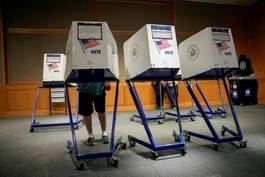
The Department of Justice is threatening top election officials in more than a dozen states with arrest if even a single vote is cast in their states by a noncitizen.
The threats detailed in a letter stating it's illegal for noncitizens to vote and giving elections officials five days to detail how they will comply with federal law.
It's worth noting that noncitizens voting, as well as election fraud in general, is exceedingly rare in this country, with just a handful of reported cases, even in databases kept by conservative legal groups.
The letter was obtained by Votebeat.
Its editorial director, Jessica Huseman, she joins us now.
So, Jessica, which states exactly received this letter and what exactly is the DOJ asking for here?
JESSICA HUSEMAN, Editorial Director, Votebeat: All of the states got the letter, which that was not initially obvious when this was reported for the first time.
We heard from several states all at once that had gotten it.
There were several states that couldn't actually find the letter because the Trump administration sent it to things like info@secretaryofstate.gov for some of these Web sites.
So they had to go hunt it down.
But, yes, all 50 states have gotten them.
And the letter essentially reminds election administrators that noncitizen voting is illegal and says that there are criminal penalties associated with knowingly allowing a noncitizen to vote.
Of course, that is not new information to election officials.
And all of the election officials that I spoke to about this yesterday didn't seem particularly concerned.
AMNA NAWAZ: So is noncitizen voting something the election officials are worried about in the states you talk to?
And how worried are they that there could be some kind of criminal penalties if they don't comply with this DOJ demand?
JESSICA HUSEMAN: You know, I think that states are genuinely not concerned about noncitizen voting.
As you said in the run-up, it is exceedingly rare.
It very rarely happens.
Election administrators, especially in the last couple of years, as the Trump administration has made this sort of their preferred election issue to talk about it, have done things like done huge reviews of their entire state's voter rolls.
Georgia just completed that a few months ago.
And they did find a few, right?
That happens.
This is a human-run system.
But it's really, really small numbers, and I think the suggestion that election administrators are knowingly allowing people who are not qualified to vote to cast a ballot stretches the imagination.
I have been covering this a long time.
I haven't met an election administrator that I think would knowingly violate the law.
AMNA NAWAZ: And yet there is this threat of potential arrest that's in this letter.
We have also seen the administration threaten to, for example, withhold anti-terrorism funding if states didn't comply with the president's election agenda, like requiring paper ballots or citizenship checks.
So are states looking at that as empty threats or a pressure campaign of a different kind?
JESSICA HUSEMAN: You know, I think that they're kind of looking at it as both, right?
I think that this is a definite and defined pressure campaign.
As you say, there are threats of funding.
There are threats of criminal penalties.
There are lawsuits in a number of states.
But I think that election administrators who have to wake up every morning and make the elections happen are looking at the practical reality of this.
If you look at the way that Trump and the DOJ have or have not succeeded in these court battles, the election administrators have a point, right?
They have been screaming at them for a couple of years now, and certainly they did this in the first Trump administration as well.
But almost nothing that they do ultimately has real-world consequences, because they approach it in such bizarre and extralegal ways.
AMNA NAWAZ: Related to what you're noting here, we should point out and underscore that, just yesterday, there was a federal judge who blocked the DOJ demand for personal information of everyone who worked in the Fulton County, Georgia, election office.
But if you step back, Jessica, and, look, as you mentioned, this is a human-run system, and it's not one system, right?
There are 50 different systems relying on thousands of local jurisdictions.
When you look at the various ways that pressure or threats have been applied or deployed, is there a broader impact on the way elections are run when you look at the people who we depend on to run it?
JESSICA HUSEMAN: Absolutely.
I think that really these people are exhausted.
They are having to do things that are not part of their normal jobs and are expressly not helpful to voters.
Demanding that they do these kind of reviews in the run-up to an election that is already under way, when the problem they're trying to find does not exist, is simply not a good use of time for election -- for America's election administrators, especially when we have got an election that's basically under way.
There are primaries happening now.
November is basically tomorrow in many of these people's minds.
And so all of the added pressures are taking away from the space and time that they have to dedicate to what their actual job is, which is making sure that everyone who walks in the door to vote is handed a ballot and that ballot is counted accurately.
That's a huge job, and all of these responsibilities are really starting to add up.
And we're seeing huge burnout and quite a lot of turnover.
AMNA NAWAZ: All right, we will see what kind of impact this has on the upcoming midterm elections.
And, meanwhile, that is the editorial director of Votebeat, Jessica Huseman, joining us tonight.
Jessica, thank you so much.
JESSICA HUSEMAN: Thank you.
GEOFF BENNETT: For the past few weeks, visitors have flocked to the National Mall for the Great American State Fair, part of the celebration marking the nation's 250th anniversary.
But in this milestone year, President Trump's approach to commemorating the anniversary has injected a more partisan tone into events meant to bring Americans together.
Liz Landers reports now from the fair.
LIZ LANDERS: America's 250th birthday went off with a bang last weekend, and a Salute to America program on the National Mall, complete with military flyovers, patriotic songs, and President Trump center stage speaking for more than a half-hour, weaving American history... DONALD TRUMP, President of the United States: American grit, boldness, and daring forged heroes like Davy Crockett, Wyatt Earp, Annie Oakley, Teddy Roosevelt.
LIZ LANDERS: ... with overtly political statements.
DONALD TRUMP: And all these talks from the communists, they haven't got a chance, not even a chance.
We don't want communists in our country.
LIZ LANDERS: This stretch of civic space that has seen inaugurations, protests, and fireworks is now currently playing host to the Great American State Fair organized by Freedom 250, the Trump-aligned group putting on many of the 250th anniversary events in the nation's capital.
Organizers describe the gathering as a modern-day World's Fair to celebrate American people, traditions, innovations, and spirit.
But the fair has been plagued by record high temperatures, severe weather in Washington, and mocked by critics for low turnout.
Many of those that showed up were impressed.
KARL MINACAPELLI, Maryland Resident: Look, it's a rare opportunity to celebrate our country.
I was around in '76 for the bicentennial.
They didn't have anything this grand.
I think this is pretty cool.
LIZ LANDERS: The free event kicked off last month with a rally featuring President Trump and runs through July 10.
DONALD TRUMP: Tonight, right here on the National Mall, we are beginning the most unforgettable birthday party any country has ever seen.
Oh, you're going to have a good time.
LIZ LANDERS: But it's not been without controversy.
Soon after the fair announced a lineup of musical performers, many of them, like country singer Martina McBride and rock performer Bret Michaels of Poison, withdrew from the event.
McBride wrote on social media -- quote -- "I was presented with the opportunity to perform at a nonpartisan event, but that turned out to be misleading."
Even one of the president's supporters that we spoke with acknowledged Trump has made the milestone birthday a bit political.
Do you think he's made it political?
JIM SANDER, Pennsylvania Resident: Do I believe -- a little.
I know what he's thinking, because he says what he thinks.
(LAUGHTER) JIM SANDER: There's no guesswork about it.
(LAUGHTER) JIM SANDER: But he's his own worst enemy, I think, sometimes.
LIZ LANDERS: It's MAHA Monday at the Great American State Fair here.
We're on the National Mall in Washington, D.C., and every day has a different theme.
Every state and some federal agencies have been invited to participate and put up booths here.
And this is all being organized by Freedom 250, which is a Trump-aligned organization, to celebrate America's 250th birthday.
That group, Freedom 250, was formed by an executive order President Trump signed shortly after he was inaugurated, and has produced a number of events, like the Mount Rushmore celebration last week and the upcoming IndyCar race throughout D.C.
But Freedom 250 has been in direct conflict with another group, America 250, a nonpartisan commission established by Congress a decade ago to plan anniversary events.
That group hosted a concert on July 4 in Los Angeles and created a time capsule.
But for the fair, its ties to the Trump-aligned group have caused some hiccups and cost the participation of some Democratic-led states.
The governors of both Maine and Connecticut did not send official delegations to the Great American State Fair.
There are more than half-dozen states that are not participating.
Congressional Democrats have accused the Freedom 250 organization of deceiving donors and misdirecting money intended for the bipartisan America 250 Commission.
A Freedom 250 spokeswoman denies the allegations, calling them a -- quote -- "partisan smear" that are -- quote -- "categorically false."
Matthew Levendusky, a political science professor at the University of Pennsylvania, penned a book on bridging political partisanship.
He says, ideally, there would be one bipartisan organization working to celebrate America.
MATTHEW LEVENDUSKY, University of Pennsylvania: When you end up with these competing bodies, right, then even this event and day that should be unifying ends up being divisive and combative because it ends up reinforcing that narrative of polarization and division.
LIZ LANDERS: The fair has also put another of Trump's controversial plans front and center as he tries to rebuild public sites in Washington in his image.
One of the sites at the fair is this triumphal arch, which has become a pet project of President Trump's.
The real one, though, is going to be much larger, 250 feet tall.
Hannah Turer lives in Washington and came to the fair to check things out.
She said nothing at the event was catching her eye, and it seemed political.
Do you think that this 250th birthday celebration has become political?
HANNAH TURER, Washington, D.C., Resident: Yes, I mean, 100 percent.
There's definitely state booths also that just have Trump's face plastered everywhere.
So it's not even a celebration of the country.
It's kind of the states that support him are celebrating him mostly, more than just showing off what their state has to offer.
LIZ LANDERS: Levendusky says that, when Americans reflect on the history of the country at 250 years, for many people, it's not necessarily political, but it can become politicized.
MATTHEW LEVENDUSKY: Many people would see this is a day that's about America without a lot of political context, but that when you do things like, say, give a speech at Mount Rushmore, where you talk about communism, right, and you talk about your enemies, right, that you are setting up a more political context.
So you can bring politics into these things and make them more political, even if they're not necessarily inherently political on their own.
LIZ LANDERS: Fairgoers we spoke with do agree on one thing, though.
When it comes to America's future, they hope the country can unite.
Where do you want to see America in 50 years?
HANNAH TURER: I would like to see us just be a more inclusive place.
I think the country is very divided right now, and I think it causes a lot of tension between friends, colleagues, families.
So it'd be nice if everyone can get a little bit more aligned.
LIZ LANDERS: What do you hope to see for America in another 50 years?
CINDY MINACAPELLI, Maryland Resident: I would like to see the country come together a little bit more.
This is probably the most divided in my lifetime I have ever seen.
LIZ LANDERS: For the "PBS News Hour," I'm Liz Landers.
GEOFF BENNETT: Family members and local officials are calling for a full investigation into the shooting death of a man killed by ICE agents in Houston.
Lorenzo Salgado Araujo was shot yesterday as ICE agents tried to arrest him.
Federal officials say he tried to flee and -- quote -- "weaponized his vehicle toward an ICE officer who opened fire in self-defense."
Salgado Araujo was shot in the abdomen and taken to a hospital, where he later died.
ICE says he was a Mexican national living in the U.S.
without legal status.
His family and immigration advocates are questioning the official account, saying ICE has yet to provide evidence to support their claims.
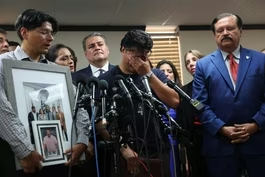
One of his sons spoke at a news conference today.
RONALDO SALGADO, Son of Lorenzo Salgado Araujo: I am calling for a full investigation into the events that transpired yesterday -- yesterday, July 7.
He did not deserve to die.
He did not deserve to be reduced to a headline of Mexican man shot and killed by ICE.
He deserved to live a quiet life as Lorenzo Salgado Araujo, a husband, a father, and a job creator for dozens of men who also wanted the American dream.
GEOFF BENNETT: Colleen DeGuzman joins us now.
She's a reporter for The Texas Tribune.
So, Colleen, thank you for being with us.
So, DHS says Salgado Araujo rammed an ICE vehicle, that he ignored repeated commands and that he tried to run over an ICE officer.
What evidence, if any, have they provided to support their accounts?
COLLEEN DEGUZMAN, The Texas Tribune: We have received very little evidence and very little explanation.
What we do know is that ICE was in unmarked vehicles when they stopped Salgado Araujo.
And what we heard from -- today from the brother -- from the son, Ronaldo, is that his dad -- he believed that his dad would not have tried to flee from ICE, let alone run over an agent with his vehicle.
The vehicles that ICE were using were unmarked, which is the reason why his son Ronaldo believes that his dad did not know that he was being pulled over by ICE.
His dad was a construction worker and was always worried that his tools were going to be stolen.
So that's why he thinks his dad thought he was going to get robbed and why he tried to escape.
GEOFF BENNETT: Were there eyewitnesses?
And, if so, what are they saying about what transpired?
COLLEEN DEGUZMAN: We have not been able to contact any eyewitnesses or receive any video footage yet.
But, today, at a press conference with a lot of Houston local leaders, they are pressing for body footage camera and any camera footage that there is out there on what happened in Houston's East End, which is a very Latino neighborhood.
GEOFF BENNETT: What more have you pieced together about Salgado Araujo, his life, his life in Houston, and what brought ICE agents to arrest him?
COLLEEN DEGUZMAN: Those are the same questions that we have right now.
We are unsure of whether this was targeted, whether this was just a normal traffic stop.
I was at that intersection yesterday, and there was a lot of construction in that area.
And so we're wondering if this was targeted or if this was random.
But what we do know is that Salgado Araujo had three sons.
And, today, we heard from Ronaldo, who is a teacher who is a proud University of Houston graduate.
His second son is 27 years old.
He's also named Lorenzo, Lorenzo Lorenzo Jr., and he went to Tufts University, and is an engineer.
And he has at least one grandson.
He moved to Houston 35 years ago and has built a construction company here in Houston, and he's very proud of it.
He builds homes in North Houston.
And he, according to his son, was a very simple man who had a routine in the morning to get up really early.
He would pet the dog goodbye and kiss his wife, who was his high school sweetheart, goodbye before work.
And every day, when the day ended, he would sit by his porch outside to soak up the sunset.
He was a very simple man with a very strict routine.
So that's what we know about him.
GEOFF BENNETT: The president of Mexico, Claudia Sheinbaum, says that that country is pursuing legal measures.
It's not clear what that exactly means.
There are now two separate federal investigations.
We should say, though, that the mayor of Houston says the city will not conduct its own investigation while the federal investigations are ongoing.
Based on your reporting, are there calls for local officials, local authorities to do more, to uncover more, as they can?
COLLEEN DEGUZMAN: Yes.
This morning, local leaders echoed a lot of pleas to Houston Police Department and our mayor, John Whitmire, to call a local city-led criminal investigation into what happened on our streets.
But during City Council today, Mayor John Whitmire said that it's outside of the city's hands since HPD, Houston Police Department, was not involved in this altercation.
And a local council member said it would be very difficult for local law enforcement to conduct its own investigation since it only involved federal agents.
But there is pressure from congressional representatives down to local city council members, some of them, to have their own criminal investigation.
GEOFF BENNETT: How is this resonating in Houston?
We saw protests in Minneapolis over federal immigration efforts there, immigration enforcement, rather.
Is there a sense that this incident could spark protests in Houston?
COLLEEN DEGUZMAN: From what I know right now is, the city is in the heartache stage.
We're having a vigil tonight.
And a lot of people are grieving with the family for the loss of the dad and the detention of the three other men who were in the same vehicle with him.
From what we know, one of them was his brother, Ronaldo's uncle.
And so I'm unsure if this is going to spark protests, because the -- what I'm sensing from my reporting here in Texas so far is that a lot of people are in hiding.
And so that's really leading people to be nervous about going out in public, to be speaking out against the administration, especially here in Texas, where Governor Greg Abbott is supportive of President Trump's agenda to carry out the largest mass deportation operation in the country's history.
And so I think it's going to be very different here in Texas, and especially here in Houston, which is one of the most diverse cities in the nation, especially where this happened, in Houston's East End, which is a heavily Latino neighborhood.
GEOFF BENNETT: Colleen DeGuzman of The Texas Tribune speaking with us from Houston.
Thank you, Colleen.
COLLEEN DEGUZMAN: Thank you for having me.
AMNA NAWAZ: Well, the Trump administration has fired more than 100 immigration judges as it moves to reshape the court system that polices deportations in this country.
Those sitting judges report it's led to a pressure campaign, as they're being pushed to meet the administration's policy goals, rather than the law itself.
Our Ali Rogin spoke with a judge at the center of it all.
ALI ROGIN: Unlike most federal courts, immigration courts are overseen by the Department of Justice itself.
That means judges are required to answer ultimately to the administration on whose policies they're ruling.
While immigration judges say every administration tries to shape the courts in their own image, the Department of Justice has taken more drastic measures during Trump's second term to ramp up deportations and fire judges they view as too lenient.
I'm joined now by Holly D'Andrea.
She has served as an immigration judge in Texas since 2019.
She's also president of the National Association of Immigration Judges, the union that represents the courts.
Judge D'Andrea, thank you so much for joining us.
How has this administration put pressure on immigration judges to achieve its agenda?
JUDGE HOLLY D'ANDREA, President, National Association of Immigration Judges: So, usually, the immigration judges have kind of a soft pressure from the presidency.
And it's more done through policy and just a very soft way of saying, like, hey, you should really be following the policy over the law.
But in the current administration, we have actually had a more firm pressure on the immigration judges, even sometimes having immigration judges threatened with actual disciplinary action if they follow the law, instead of following the policy.
ALI ROGIN: And we have seen a number of judges being fired.
How has that affected your caseload and morale within the courts?
JUDGE HOLLY D'ANDREA: Well, the morale is really low.
When you have had -- we have had at least 200 judges who have been fired, who have resigned, or who have retired because of the circumstances right now in the immigration court and their concerns about due process.
And, ultimately, all attorneys and judges in the United States owe a allegiance to the Constitution of the United States.
And due process is a part of that Constitution.
So a lot of judges felt conflicted and they have resigned under the current administration because of concerns about - - and due process concerns in the court.
It's definitely disheartening.
And when you're on the court every day, it makes your job a lot harder.
For each immigration judge that's fired, resigned or retired, that's the equivalent of 700 cases.
So those 700 cases have to be reassigned to another judge.
So if you do the math and whatever 700 times 200 is, that's the bare minimum of how many cases have been reset on other judges' dockets.
So some judges are hearing well above 1,000 cases, 10,000 cases.
Some, even 12,000 cases are sitting on their dockets waiting to be heard because of the firings that have occurred.
ALI ROGIN: The Department of Justice has also been hiring what it calls now deportation judges.
What are your concerns about the people who are seeking out and getting those jobs?
JUDGE HOLLY D'ANDREA: We don't know those judges.
They have just come on the bench.
Some may end up being very, very good judges, but we do have concerns about training and making sure that they're properly trained.
They have shortened the training process for judges to get onto the bench to be able to fill the need.
But it's a real concern, because you want judges who you know are going to be fair, and you want judges who are going to listen to the evidence that's on - - that's in each individual case.
And the lack of training really weighs in on how they're able to do that, especially as they're taking on large caseloads when they're new to the bench.
ALI ROGIN: The Supreme Court recently ruled that the Trump administration could end Temporary Protected Status for Haitian and Syrian migrants.
How do you anticipate that is going to affect the work that you do?
JUDGE HOLLY D'ANDREA: Well, we will definitely probably see more of those cases.
There will be an increase in asylum cases and cases for withholding of removal and protection under the Convention Against Torture, no doubt, from those people who were -- who were under TPS.
ALI ROGIN: And there are a number of other court cases that pertain to the work you do, that pertain to immigration policy, many of which are actively being adjudicated right now, moving through different appeals, going through different statuses, changing rapidly.
How does that affect your work, this rapid change in some of the policies that you all are expected to follow?
JUDGE HOLLY D'ANDREA: Yes, it's a day-to-day struggle.
Every single day, the law is changing underneath us, and some days you don't know how that law is going to change.
For example, last week, the Fifth Circuit issued a decision regarding bonds, and we shifted our functioning in the immigration court to accommodate that decision.
And then the Fifth Circuit stayed the mandate, which means that they're waiting to hear the case en banc with the entire Fifth Circuit, instead of just the three judges that originally heard it, to review the case.
And so now, within just yesterday morning alone, we had to switch tactics again and go from granting bonds to not granting bonds, because the law was shifting that quickly.
ALI ROGIN: Wow.
And that's unprecedented, would you say?
JUDGE HOLLY D'ANDREA: Yes, that's definitely unprecedented.
But we have always had shifting law in the immigration courts.
Every four years under policy and the policy influence of the courts, the laws shift back and forth, and you have an ever-changing set of laws in the immigration court, which is one of the reasons why the National Association of Immigration Judges is advocating for an Article I court -- independent immigration court.
And that would take the court out from underneath the executive and make it an independent administrative court, so that you would no longer have that same policy influence every four years.
And that policy influence could go to the enforcement branches with the Department of Homeland Security, where it belongs.
ALI ROGIN: Judge Holly D'Andrea, president of the National Association of Immigration Judges, thank you so much for joining us.
JUDGE HOLLY D'ANDREA: Thank you.
AMNA NAWAZ: As the cost of living continues to rise in the United States, people are finding it more and more difficult to make ends meet.
And older Americans are feeling it more than most.
GEOFF BENNETT: And, as Paul Solman reports, that's forcing many retirees to unretire.
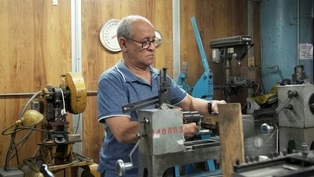
CHRISTINE DRINKS, Office Manager: How are you doing?
PAUL SOLMAN: Seventy-one-year-old Christine Drinks, the first phase folks see in a veteran support group just outside Atlanta.
Did you ever expect to be working at this age?
CHRISTINE DRINKS: No, no, no, absolutely not.
PAUL SOLMAN: Never even thought of it.
CHRISTINE DRINKS: No, no, not at all.
PAUL SOLMAN: Do you feel put upon that you have to work?
CHRISTINE DRINKS: Yes.
Yes.
PAUL SOLMAN: You think it's unfair?
CHRISTINE DRINKS: It is, most definitely.
I mean, you work all your life, so this is what you look forward to, retirement.
And you're thinking that you're going to be OK.
You had called and needed help with... PAUL SOLMAN: Drinks retired in Maryland a couple of years ago to come down to Georgia to care for her 96-year-old mom.
CHRISTINE DRINKS: From back in my mom's day, you were OK because they got to retire at a very early age.
And they got to retire and enjoy their life.
That's not like that anymore.
It's just too much with the price of everything.
It's very, very difficult out here for elderly people.
And it's really sad that we were put in that boat, but that's where we are.
PAUL SOLMAN: Social Security doesn't cover the new cost of living.
So I asked: Do you have savings?
CHRISTINE DRINKS: Yes.
Yes.
PAUL SOLMAN: Are you drawing it down?
CHRISTINE DRINKS: Yes.
Yes.
Oh, am I. PAUL SOLMAN: How long before it goes away?
CHRISTINE DRINKS: I don't know.
I'm trying to curtail the best I can.
(LAUGHTER) CHRISTINE DRINKS: Trying.
PAUL SOLMAN: For the elderly, as for most unretirees, financial insecurity is the driver, though folks also return to work for so-called good reasons, like a sense of purpose, but mainly: GEOFFREY SANZENBACHER, Boston College: Right now, when it's hard to find a job, when you have high inflation, you're going to tend to see people unretire for the bad reasons.
PAUL SOLMAN: Moreover, says economist Geoffrey Sanzenbacher: GEOFFREY SANZENBACHER: People who have to unretire for economic reasons can be a lot less choosy.
So they're going to come back to whatever they can find, and they're probably going to make less than they did before, and probably not because they're taking a job they like more.
PAUL SOLMAN: Stories of older Americans working all the rage online, like 78-year-old food delivery driver Richard Pulley (ph).
He came out of retirement when his wife lost her job in an economy with inflation at its highest rate since April 2023.
MIRNA COLOMBO, Nurse Aide: I have cut down on buying for anything at all that is not really necessary, like basic things, food, hygiene, cleaning items.
PAUL SOLMAN: Orlando-based Mirna Colombo feels the economic pressure too.
Unretired at age 63, now working as a nurse's aide, she makes between $12 and $16 an hour.
When do you think you will be able to retire for real?
MIRNA COLOMBO: I don't see it.
Number one, I have to be very realistic of the current status.
I don't see it.
PAUL SOLMAN: Ever?
MIRNA COLOMBO: No, I do not see it.
I have to go back to work because medical expenses, bills.
PAUL SOLMAN: Same for Richard Lobinske in Northern Florida, an environmental administrator now making $75,000 a year.
RICHARD LOBINSKE, Environmental Administrator: Health insurance was pretty expensive, and my wife and I both definitely need insurance.
We have got chronic conditions that require regular care.
My father-in-law's health declined, and we spent a considerable amount of money in his end-of-life care.
So, by the time -- after all of that, most of my retirement savings was gone.
So I start -- then I started looking for work.
PAUL SOLMAN: More than half of Americans say they can't afford medications and needed health care,a five-year low, even though Americans have been retiring later.
GEOFFREY SANZENBACHER: There was a long trend towards earlier and earlier retirements as people had pensions and as Social Security came online.
And that started to flip in the '90s.
And so we have seen about a two-year increase since the turn of the century.
PAUL SOLMAN: But landing a job for retirees returning to work, no piece of cake.
CHRISTINE DRINKS: Well, it took me over two years.
Jobs look at you like, you don't have a whole lot of life left for me to hire you.
PAUL SOLMAN: The unretirement rate actually peaked in 2022, in part because of a strong job market post-pandemic.
But says the economist, compared to so much of the recent past: GEOFFREY SANZENBACHER: Now we have a rising cost of living and not necessarily as many job openings.
And that's what's going to be something I'm really keeping an eye on is, can people unretire even if they want to?
Back then, they wanted to, they could.
PAUL SOLMAN: Our final unretiree, 80-year-old Anita Sawyer, a $7.25-an-hour receptionist at the courthouse in Cuthbert, Georgia.
ANITA SAWYER, Receptionist: I was working at a sewing factory up in Cuthbert, made curtains, bed spread.
PAUL SOLMAN: After the factory closed: ANITA SAWYER: I have done different things, really retired in 2005.
PAUL SOLMAN: Why did you go back to work?
ANITA SAWYER: Because I needed the money.
I needed that extra money to survive on.
PAUL SOLMAN: What would you do to the House, for example, if you had more money?
ANITA SAWYER: I'd have a lot done, stuff in like my bathroom and my kitchen.
I would like to be able to go somewhere for a couple of days just to get away, just to have a fun day or just to get out.
PAUL SOLMAN: But you're not thinking of going to like Italy or something?
ANITA SAWYER: No, no.
Uh-oh.
(LAUGHTER) ANITA SAWYER: I don't want to go over there, no.
PAUL SOLMAN: What about another state?
ANITA SAWYER: Well, Alabama.
PAUL SOLMAN: Back in Northern Georgia, I asked Christine Drinks to sum up.
CHRISTINE DRINKS: A lot of people want to be just retired, but they can't.
And I know people who are doing some really strenuous jobs, like in the factory, doing things that they haven't done before.
PAUL SOLMAN: How hard is it on them physically?
CHRISTINE DRINKS: They go to work, and when they come home from work, they fix their dinner and they go to bed.
And then they're up in the morning doing the same thing all over, five days a week.
PAUL SOLMAN: Drinks consoles one elderly friend in particular.
What does she say to you on the phone when you talk?
CHRISTINE DRINKS: She cries a lot.
PAUL SOLMAN: Crying about the fact that she has to work in a factory?
CHRISTINE DRINKS: Yes, that she's really upset.
She's exhausted.
So we talk, and I try to pep her up and, because, honey, I said, you're not the only one.
There's a lot of people going through this.
PAUL SOLMAN: And more every day, it seems, in what's becoming a cliche, an America harder and harder for so many to afford.
For the "PBS News Hour," Paul Solman.
GEOFF BENNETT: An important story.
Well, that is the "News Hour" for tonight.
I'm Geoff Bennett.
AMNA NAWAZ: And I'm Amna Nawaz.
On behalf of the entire "News Hour" team, thank you for joining us.
As living costs soar, more retirees head back to work
Video has Closed Captions
As living costs soar, more retirees head back to work (6m 55s)
DOJ threatens election officials over noncitizen voting
Video has Closed Captions
DOJ threatens to arrest state election officials if noncitizens vote (5m 46s)

How Trump politicized America's 250th birthday
Video has Closed Captions
How Trump politicized America's 250th birthday (6m 52s)
ICE agent kills Mexican immigrant in Houston encounter
Video has Closed Captions
ICE agent kills Mexican immigrant in Houston in latest deadly enforcement encounter (7m 26s)

Immigration judge says firings, policies are 'disheartening'
Video has Closed Captions
Immigration judge says Trump administration's firings and policies are 'disheartening' (6m 24s)

News Wrap: Judge orders Carroll to be paid in Trump case
Video has Closed Captions
News Wrap: Judge orders $5.8M paid to E. Jean Carroll in Trump sex abuse, defamation case (4m 58s)
Summit shows NATO 'not in a great state,' says ex-ambassador
Video has Closed Captions
Summit revealed NATO 'not in a great state,' but it could be worse, says ex-ambassador (6m 18s)
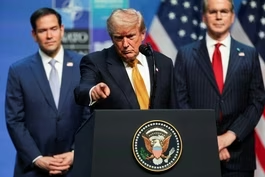
Trump says Iran ceasefire 'over' as more strikes launched
Video has Closed Captions
Trump says ceasefire is 'over' as U.S. launches more strikes on Iran (8m 11s)
Providing Support for PBS.org
Learn Moreabout PBS online sponsorship
- News and Public Affairs

Today's top journalists discuss Washington's current political events and public affairs.

- News and Public Affairs

FRONTLINE is investigative journalism that questions, explains and changes our world.


 New Episode





 New Episode
 New Episode
Support for PBS provided by:
Major corporate funding for the PBS News Hour is provided by BDO, BNSF, Consumer Cellular, American Cruise Lines, and Raymond James. Funding for the PBS NewsHour Weekend is provided by...