Is the world more dangerous after the Iran war?
Clip: 6/19/2026 | 5m 35sVideo has Closed Captions
Is the world more dangerous after the Iran war?
Iran appears to be significantly degraded as a military power, but its agreement with the U.S. could open new revenue streams for the regime. The panel discusses how North Korea or China could interpret the behavior of the United States and President Trump over the past three months.
Problems playing video? | Closed Captioning Feedback
Major funding for “Washington Week with The Atlantic” is provided by Consumer Cellular, Otsuka, Kaiser Permanente, the Yuen Foundation, and the Corporation for Public Broadcasting.

Is the world more dangerous after the Iran war?
Clip: 6/19/2026 | 5m 35sVideo has Closed Captions
Iran appears to be significantly degraded as a military power, but its agreement with the U.S. could open new revenue streams for the regime. The panel discusses how North Korea or China could interpret the behavior of the United States and President Trump over the past three months.
Problems playing video? | Closed Captioning Feedback
Where to Watch Washington Week with The Atlantic
Washington Week with The Atlantic is available to stream on pbs.org and the PBS app.
Buy Now
10 big stories Washington Week covered
Washington Week came on the air February 23, 1967. In the 50 years that followed, we covered a lot of history-making events. Read up on 10 of the biggest stories Washington Week covered in its first 50 years.Providing Support for PBS.org
Learn Moreabout PBS online sponsorshipOn April 7th, President Trump threatened Iran with complete destruction, writing, "A whole civilization will die tonight, never to be brought back again."
Earlier this week, Trump argued that Iran has a right to ballistic missiles because Saudi Arabia, its enemy, and America's friend, already has them.
Tonight, we'll take on a seemingly impossible assignment and try to make sense of America's foreign policy.
Next, this is Washington Week with the Atlantic.
Corporate funding provided by Consumer Cellular.
Additional funding is provided by Coup and Patricia Euan through the Euan Foundation, committed to bridging cultural differences in our communities.
Sandra and Carl Delay Magnus, Rose Hershel and Andy Shrieves, Robert and Susan Rosenbomb, Jay and Sharon Rockefeller, Charles Hamoy through the Charles Hamo Fund, Steve and Marilyn Kerman, Leonard and Norma Chlorifine, and by contributions to your PBS station from viewers like you.
Thank you once again from the David M. Rubenstein studio at Weta in Washington, editor-inchief of The Atlantic and moderator Jeffrey Goldberg.
Good evening and welcome to Washington Week.
Earlier this week, I spoke to an official, a very senior official of a Gulf Arab country.
I asked him, "What are we supposed to make of the fact that President Obama seems in retrospect to have been tougher on Iran than Donald Trump?
He responded, nothing really matters.
This whole deal will collapse soon anyway.
It's not real.
The Iranians and Americans were supposed to start negotiating a permanent deal today, but they're not.
This development was easily predictable.
My suspicion is that those of us who are trained to bring coherence to the news of the day are approaching our task the wrong way.
We're supposed to take today's developments in a news story and refract them through the prism of the previous day's developments and those of the day before that, and so on.
But with the Iran war and so many of President Trump's causes, we need a different approach.
Treat every day as if it's the very beginning of the story.
Joining me tonight to discuss my abstract theories and also the actual news, Jonathan Carl, the chief Washington correspondent for ABC News, Kareem Sajapore is a contributing writer at the Atlantic and a senior fellow at the Carnegie Endowment for International Peace.
David Sanger is a White House and national security correspondent for the New York Times.
and Nancy Ysef is a staff writer and a Pentagon correspondent at the Atlantic.
Thank you all for joining me.
David, you and I covered 10 years ago, 12 years ago, the first Iran negotiation on nuclear weapons, and we we understood what we were doing.
It was complicated, but we understood because there was a common set of facts, common texts, etc.
We don't have that here.
So, do us a favor in like about a minute.
Make it all make sense.
Well, the fact of the matter is we don't have anything that looks like the uh agreement that was signed in 2015.
And that's what's supposed to be negotiated from this point forward.
So, when people say, "Is this better or worse than what President Obama uh put together?"
My answer is, "We don't know yet.
We won't know for 60 days."
And anybody who's covered negotiations with Iran knows that 60 days could be months, could be years, could run to the end of the president's term, which might well be the Iranian strategy here.
So, what is this thing?
It's a 60-day ceasefire that is supposed to reopen the Straight of Hormuz.
It's supposed to end the blockade.
So immediately Iran will get the biggest gift it can get which is the resumed flow of revenue mostly from its sales of oil to China and a commitment from Iran on only one nuclear issue which is to take the existing stockpile of nuclear fuel and to essentially dilute it down to a level where it couldn't be used for a nuclear weapon.
But all the mechanisms around that are yet to be defined.
And then for the future rewards for Iran, the US has committed to them.
Lifting sanctions, unfreezing funds, but nobody knows what conditions Iran has to meet first to go do that.
So it's more like a table of contents than it is like an agreement which was the wild thing about seeing it signed at Versailles where you know there was no treaty to sign here.
There's just a table of contents.
Versailles is a whole other subject.
I mean why not do it in Munich while we're at it.
Um Kareem uh better food.
Kareem, let's um let's talk about what Iran how Iran benefits here.
Again, taking David uh taking David's point under adisement, we don't really know what's what's going to happen, but consensus is that Iran is the winner at least in the negotiation so far.
100%.
Jeff, if you read that memorandum of misunder misunderstanding is a fraud and slip uh because you know the two sides have very different takeaways of that memorandum of understanding.
But of those 14 bullet points really only one asks Iran of anything which is some nuclear compromises that it may or may not make at the end of negotiation.
And by the way, can I just interrupt and ask you the nuclear compromises that they're being asked to make were compromises that they've made in the past in the in the original nuclear deal?
Yes or no?
Are they somehow related?
Well, the two big questions are their stockpile of enriched uranium and then uh their commitment to uh suspend enrichment of uranium.
Now what's interesting is that the CIA has already picked up reporting or Axios has reported that the CIA believes that Iran doesn't actually plan to make good on those compromises.
I would say the other big defeat in this document, this memorandum of understanding is it seems to seed the possibility that Iran actually will continue to control the straits of Hormuz after the 60-day period.
And certainly the Iranians are speaking about this in a way in which we're not going back to status quo anti of the straits of Hormos being an international waterway.
This is going to be an Iranian waterway.
Let me ask you one more question.
Who is running Iran right now?
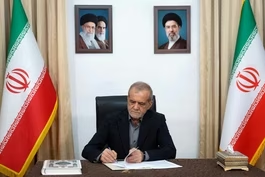
So in theory mob is the new supreme leader.
The joke in Tehran is that Trump went to press delete on Ayat and he instead pressed reset.
you know, 86 year old now a 56-year-old Ayat and you know the the reality is that we don't know the state of his health but around him are powerful revolutionary guard commanders.
Um, I would say that virtually all of those folks are what we call hardliners, but they call themselves principalists, which is they're loyal to the principles of the 1979 revolution, which makes this task that um, President Trump and now he's given this task to JD Vance that much more difficult because I think embedded in this proposal is a bet.
And the bet is that we couldn't bomb the revolution out of Iran.
Now, we're going to try to bribe the revolution out of Iran um with with financial inducements.
And that hasn't worked since 1979.
For that reason, I say this is, you know, geopolitical hail Mary for JD Vans trying to persuade Shiite revolutionaries to be a normal country.
And by the way, the same bet that Obama made.
Right.
Right.
Nancy, is this a military defeat for the US or a political defeat, assuming that it goes in the direction we're talking about?
So, let's remember what the military was assigned to do.
They were asked to damage um and degrade Iran's ballistic missile capability, its nuclear capability um and its leadership um and its ability to govern.
The military conducted 13,000 strikes and it did degrade ballistic missiles and drones, not enough that Iran couldn't continue to pose a threat to continue to use drones and missiles to um hold the street of Hormuz.
And those strikes came at great cost in that um 13 US troops were killed, one of the deadliest civilian civilian casualty incidents ever and the death of menab of at least 168 children.
And those tactical winds didn't translate into strategic success for the United States.
Now, that's not on the military to answer strategic aims, but those those strikes by themselves didn't allow the United States to achieve its initial aims of the war.
um um defeating proxies um leading to the fall of the the regime and the end of its nuclear ballistic missile capability.
I'd also add that I think it really changed how Gulf nations look at their partnership with the United States.
Up until this conflict, Gulf nations had bases um in their countries in the hopes that that presence would serve as sort of a security umbrella for them.
And what they discovered instead is that those bases and that relationship invited strikes from Iran onto their countries.
And so I think you're going to start to see them try to diversify um their security setup as a consequence of this war.
Just stay on this point about the US military for one minute.
You're an expert on US military capabilities.
The US military could have militarily defeated the Iranians had the commander-in-chief ordered the complete defeat of Iran.
Is that fair thing to say?
I mean, there were plans that went that had several carriers in the region, for example, had troop movements going in.
And there's there were were plans for it.
It be the question becomes at what cost?
And even President Trump himself said he wasn't sure that the United States had the um the stomach to to to take on the cost that would be associated with do doing it.
The military can do it.
I I think what they they live in a reality in which the politics of it doesn't allow them to do those missions as maybe they would want to do them.
Right.
U John, I want you to listen to President Trump speaking in 2018.
Um, this is when he announced the withdrawal of the United States from the Iran deal negotiated by President Obama.
As we exit the Iran deal, we will be working with our allies to find a real comprehensive and lasting solution to the Iranian nuclear threat.
This will include efforts to eliminate the threat of Iran's ballistic missile program.
Now, I want you to just listen to what the president said this past week on the same subject.
And I have guys I like some of these guys, but I don't think they're I don't think they're smart.
Sir, you shouldn't let them have any missile.
I said, well, what am I going to do?
I going to let Saudi Arabia have missiles, but they can't have them?
Yes, sir.
Can't doesn't work that way.
You know, it doesn't work that way.
And missiles aren't the problem.
Missiles are they hurt a little location, but they don't blow up the planet.
I want you to do two things here.
One, explain this about face on the question of efficacy and power of ballistic missiles.
Give us your general impressions of what's going on with him um intellectually, politically in his capabilities.
Well, well, look, I mean, what happened here is, I mean, he he was pretty transparent about it.
He said, "We had a choice.
Make a deal with Iran or have a global recession."
Uh, Iran had him over a barrel, as the Wall Street Journal put it, over a barrel of oil.
Uh, they were able to choke off the uh, you know, a critical point for the global economy and continue to do it uh, indefinitely.
He had the choice of try to, you know, continue militarily or strike a deal, any deal.
and he struck a deal that was that looked a heck of a lot like total capitulation uh to the Iranians.
What's happening with him?
I mean, look, first of all, I I I think it was remarkable to hear the way US officials talked about this deal as it came together.
Basically saying, don't look at the words.
The words don't really matter.
I mean, there's an actual quote um from a senior US official to CNN.
People shouldn't read too much into the language of theou.
It's the understandings we have with them which is so much more important.
The understandings uh I mean the language of the what does that even mean?
Well the language of the for instance by the way this is more than a table of contents I would argue because the benefits to Iran are are frontloaded.
I mean they get immediate access to the u to the world oil markets and the banking system to carry out those transactions.
This is something that they have not had since the uh Obama deal was in effect for nearly a decade.
They have not had access uh to the global oil oil markets and the banking system and the eur and the insurance system and all of that.
They can only sell on the black market at a deep discount.
This is a credible economic boom.
And then as Kareem mentioned, they have the possibility in another 58 days or so to work out a system for tolling in the straight of Hermu, something they never had.
So they have revenue streams that they have not had for a long time as a result of this agreement.
Look, Iran didn't win the military conflict.
They got set back significantly.
Their missiles missile uh program got set back significantly.
Not as much as, you know, Trump had claimed, but but but significantly.
The nuclear program clearly set back.
uh but they won the peace negotiation.
Just so we're clear, Nancy, talk about the ballistic missile program and why it is a source of anxiety for the West.
So very simply, the ballistic mo program allows um Iran to pose a threat to every US ally in the region from Israel through the Gulf partners and once they have that capability, they can launch at infrastructure in the Gulf.
They can threaten the security uh umbrella on which the Gulf operates on.
They can threaten Israel and they can use those to close the street of Hormuz.
The way they closed it was not by having a superior uh military force.
It was the threat of them conducting attacks that stop ships from going through.
So it really is a cornerstone of their security and and it is one of the most um cap durable um capabilities that they retain.
They can use it in a in a variety of ways that in conjunction with drones allows them to swarm air defense capabilities such that the US is having to expend a tremendous amount for every air defense missile in in in response to $30,000 drones and ballistic missiles.
And so those two capabilities really are the foundation of their defense and their attack on the straight.
And and David, of course, you need a ballistic missile to deliver a nuclear weapon effectively.
You do.
I mean, you can deliver a nuclear weapon on an ox cart, but if you're going to do it with a with distance, uh you you're going to need a missile.
So, there are a few things going on here.
You may remember that there was a moment when Secretary of State uh Marco Rubio got tired of everybody saying, "You've forgotten about your original objectives."
And he said, "Go write some down."
And he made the most comprehensive argument about why the missile program is designed to protect the nuclear infrastructure.
that you can't deal with one without dealing with the other, which may be why he looks so uncomfortable in the background in that clip.
And this was the flaw in a lot of critics minds of the Obama deal that it disagregated the delivery system from the from the weapon itself.
That's right.
And there were some very legitimate complaints about the Obama uh agreement.
One of them to remind was it didn't cover missiles at all.
There was a UN resolution, but it was never enforced particularly.
The second was it ran out.
There was a a time limit on it.
Well, when you read at least the outline of the accord here and what they're going to negotiate about, missiles aren't even mentioned in this 14 paragraph document.
And there is discussion of a time limit during which time Iran would presumably in the next agreement uh suspend their enrichment of uranium but then presumably could resume and that so the problem is that the president himself in that clip you played from 2018 set up the complaints he had about the Obama era deal and he now appears to be replicating many Right.
Right, Kareem.
Something John said really struck me.
Uh, you're describing a situation where where the administration is planning for a vibes-based negotiation.
Don't listen to the words and read the language.
Just there's a lot of stuff that's unspoken.
Do the Iranians do vibes-based negotiating?
It hasn't worked since 1979.
Um, but I I do think John is absolutely right.
I mean, what I'm reminded of is Trump's attempts to do a grand deal with Kim Jong-un in his first term.
If you remember, the way he spoke about that is you have beautiful coastline in North Korea.
You know, we can open you up.
It was essentially uh denuclearization in exchange for prosperity.
And the thing about revolutionaries is that what's most important for them is staying in power.
And so for them, the prosperity of their citizens, global integration is never the priority.
And so from the vantage point of our negotiators, they're guys with, you know, real estate and finance backgrounds.
And this would seem a no-brainer if you offer people hundreds of billions of dollars of relief versus continued uh isolation seems like a no-brainer.
But for the revolutionaries ruling Iran, they fear that if you open up that country to the forces of international capitalism and civil society, that's going to hasten their collapse, not entrench them.
And what does all of this mean for the dissident movement in Iran, which obviously before the the current war um had been active, but then brutally suppressed, thousands upon thousands of people killed by the regime.
What does it mean for them?
For the moment, it's it's it's dead.
You know, there's enormous hopelessness among Iranian opponents of the regime.
President Trump said on nine occasions, help is on the way.
Most recently, I heard him say, "I don't care about regime change."
And he and he's actually referred to regime change that has already taken place in Iran, saying that Iran's new leaders are are moderate.
Moab is a respected figure.
So this is I think one of the modern tragedies that you know America used to be the beacon on the hill for freedom fighters around the world and and President Trump is you know in our the words of our colleague an apple bomb unilaterally disarmed the United States of our of our soft power and support for democracy right um John all of this raises this big question is is the world more dangerous now than it was before February 28th when this war started.
I want you all to answer that question.
Well, I I I mean I I think you can make an argument that that Iran has been significantly degraded as a military power.
So in the But can it rebuild?
And and and I mean it's going to have the means, the financial means to rebuild.
China and Russia interested in helping it's uh I mean it's going to have its own it's gonna have new revenue streams whether or not I mean I I I don't know the answer to those questions but but it will have the means to rebuild.
for right now, for the short term, maybe the midterm, you can argue that Iran is a diminished power and has less of of an ability to inflict harm on on its neighbors.
Uh but these larger questions about whether or not they can rebuild, how quickly they can rebuild, their missile capabilities, their drone capabilities, which haven't really been degraded very much, and ultimately a nuclear program.
I thought it was striking to look at the agreement and refer to the it refers to the Islamic Republic of Iran's nuclear needs.
Mhm.
It it's acknowledging, it seems to me that they will at some point have a right to continue to enrich uranium, something that had been, you know, a red line for Trump at the beginning of this.
Nancy, expand this out a little bit.
If you're North Korea, which has appetites mainly for South Korea, if you're China that has an appetite for Taiwan, how are you looking at the behavior of the United States, United States president over the past three months?
And how are you how are you interpreting that and what are you learning?
So for China, I'm watching um in terms of Taiwan, I think they're seeing the United States that's been depleted in terms of its airmunition capability.
Its navy has really taken the brunt of um the war fighting by the United States.
We've had um carriers and destroyers in the region.
And so I think they're watching that and might assess that the United States is weaker in terms of responding to threats to Taiwan.
I think broadly the international community is looking at what happened not only in Iran but in Ukraine and seeing that this idea of sort of large powers coming in and definitively defeating other weaker nations is not necessarily the case anymore.
That technologies become such an an equalizer on the battlefield.
And so I think you're going to see militaries across the world, including the United States, look at their technological capabilities, look at their drone capabilities, look at AI, and figure out what advances they need to make given this rapid moving and changing battlefield dynamic.
Right.
Um, David, uh, you can answer that question if you want, but I want to add something to the mix.
I want to talk about Trump's relationship with Benjamin Netanyahu.
Um, as Henry Kissinger once said, as you know, uh, it may be dangerous to be America's enemy, but to be America's friend is fatal.
Did Did Trump just play Netanyahu for a sucker here?
I think that President Trump came to realize that Netanyahu may have been playing him at the beginning and reacted to this.
Listen, Israel and the United States went into this war together.
Right.
Right.
They attacked Iran simultaneously.
They discussed how much they had a common interest in it.
They left the war deeply separated with the president having had shouting matches with Netanyahu and so forth.
Why?
Because their interests diverged.
Netanyahu still wanted to go defang Iran and didn't think that they had accomplished that.
President Trump said something really revealing I thought when he was in Europe twice he mentioned a predecessor of his in the Oval Office who most American presidents don't discuss Herbert Hoover and he said I don't want to become that Herbert Hoover guy.
So basically what he was saying was we were headed to a position of energy disruption and of recession and maybe depression he said and he had to pull the plug on that which tells you he was endorsing the Iranian strategy.
Why didn't he think of that beforehand?
Really good question.
And the when historians look back at this at this misbgotten uh adventure, I think the question they will be asking is what was it about the Trump structure here that led them to anticipate so few of the counter moves that Iran made.
Right.
I I I I think if I can just jump I think the answer here is that Trump had a belief in his own invincibility.
It was driven in part by the incredible success in relative ease of the Venezuela operation to get rid of Maduro.
It was driven by the success of the bombing last summer of the nuclear sites and even of the bombing of the of the boats in the Caribbean.
He thought he can do anything.
Right.
Kareem, last 25 seconds to you.
World more dangerous?
I think it is more dangerous because the lesson that Iran learned uh in the last four months is that you you gain concessions from the United States by punching back at them hard by closing the straight of Hermuz by attacking your neighbors.
And unfortunately, I I don't think this has resolved the nuclear issue.
I expect that Iran is actually going to try to acquire nuclear weapons.
Well, on that happy note, we're going to have to leave it there.
Um, I want to thank our guests for joining me and I want to thank you at home for watching us.
You could read Kareem and Nancy on Iran by visiting theat atlantic.com.
I'm Jeffrey Goldberg.
Good night from Washington.
Corporate funding for Washington Week with the Atlantic is provided by.
In 1995, two friends set out to make wireless coverage accessible to all with no long-term contracts, nationwide coverage, and 100% US-based customer support.
Consumer Cellular Freedom Calls.
Additional funding is provided by Coup and Patricia Euan through the Euan Foundation committed to bridging cultural differences in our communities.
Sandra and Carl Delay Magnus, Rose Herschel and Andy Shreves, Robert and Susan Rosenbomb, Jay and Sharon Rockefeller, Charles Hamoy through the Charles Hamo Fund, Steve and Marilyn Kerman, Leonard and Norma chlorifying, and by contributions to your PBS station from viewers like you.
Thank you.
Hey, You're watching PBS.
How Iran benefits from Trump's deal and what's next
Video has Closed Captions
How Iran benefits from Trump's deal and what's next (18m 12s)
Providing Support for PBS.org
Learn Moreabout PBS online sponsorship
New Episode- News and Public Affairs

Top journalists deliver compelling original analysis of the hour's headlines.

- News and Public Affairs

FRONTLINE is investigative journalism that questions, explains and changes our world.

New Episode
New Episode


New Episode


New Episode

New Episode

New Episode


New Episode
Support for PBS provided by:
Major funding for “Washington Week with The Atlantic” is provided by Consumer Cellular, Otsuka, Kaiser Permanente, the Yuen Foundation, and the Corporation for Public Broadcasting.