Finding Your Roots
American Dreams
Season 12 Episode 1 | 52m 9sVideo has Closed Captions
Henry Louis Gates, Jr. uncovers America Ferrera & Darren Criss’ immigrant ancestors.
Henry Louis Gates, Jr. helps actors America Ferrera and Darren Criss uncover their immigrant roots—telling stories of revolutionaries in Honduras, a Dutchman who helped build New York City, and a young woman from the Philippines who brought her family to California against great odds. Along the way, family histories are brought to light—and America and Darren come to see themselves in a new way.
From
Problems playing video? | Closed Captioning Feedback
Problems playing video? | Closed Captioning Feedback
Corporate support for Season 11 of FINDING YOUR ROOTS WITH HENRY LOUIS GATES, JR. is provided by Gilead Sciences, Inc., Ancestry® and Johnson & Johnson. Major support is provided by...
Support provided by:


Finding Your Roots
American Dreams
Season 12 Episode 1 | 52m 9sVideo has Closed Captions
Henry Louis Gates, Jr. helps actors America Ferrera and Darren Criss uncover their immigrant roots—telling stories of revolutionaries in Honduras, a Dutchman who helped build New York City, and a young woman from the Philippines who brought her family to California against great odds. Along the way, family histories are brought to light—and America and Darren come to see themselves in a new way.
From
Problems playing video? | Closed Captioning Feedback
How to Watch Finding Your Roots
Finding Your Roots is available to stream on pbs.org and the free PBS App, available on iPhone, Apple TV, Android TV, Android smartphones, Amazon Fire TV, Amazon Fire Tablet, Roku, Samsung Smart TV, and Vizio.
Buy Now
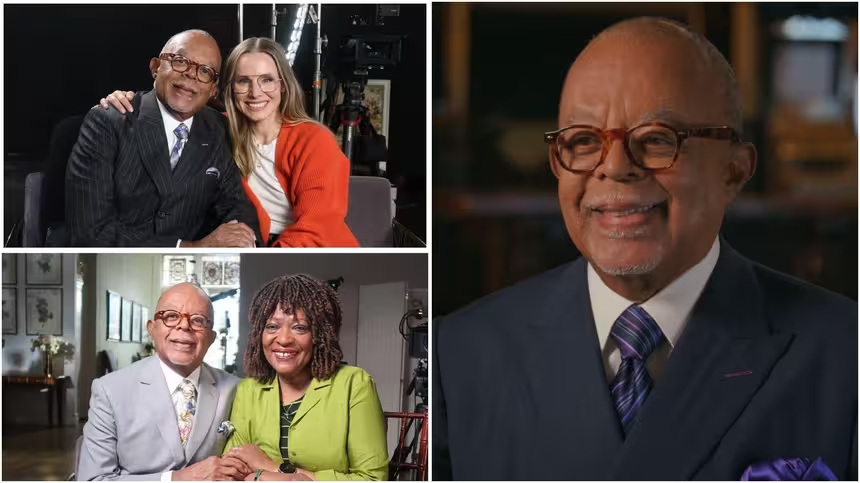
Explore More Finding Your Roots
A new season of Finding Your Roots is premiering January 7th! Stream now past episodes and tune in to PBS on Tuesdays at 8/7 for all-new episodes as renowned scholar Dr. Henry Louis Gates, Jr. guides influential guests into their roots, uncovering deep secrets, hidden identities and lost ancestors.Providing Support for PBS.org
Learn Moreabout PBS online sponsorshipGATES: I'm Henry Louis Gates Jr.
Welcome to "Finding Your Roots."
In this episode, we'll meet America Ferrera and Darren Criss, two actors who grew up knowing very little about their very recent ancestors.
FERRERA: Wow, this is not what I was expecting to learn, it's awesome.
CRISS: My family was my immediate family.
Yes, we had family in the Philippines, but that was far away.
GATES: Yeah.
CRISS: This will be the most connected, I think I'll ever, I'll have ever been in my life to, to grandparents and beyond.
GATES: To uncover their roots, we've used every tool available.
Genealogists comb through paper trails, stretching back hundreds of years.
FERRERA: Oh, I love that.
GATES: While DNA experts utilize the latest advances in genetic analysis to reveal secrets that have lain hidden for generations.
CRISS: Yeah, cool.
Oh, man!
GATES: And we've compiled it all into a Book of Life.
FERRERA: Wow.
GATES: A record of all of our discoveries.
CRISS: Woo.
GATES: And a window into the hidden past.
America, this is a love letter.
FERRERA: Oh my God, a love letter?
GATES: Written by your grandmother.
FERRERA: Stop it, I'm dying.
CRISS: What an amazing, what an ama... GATES: It's a miracle.
CRISS: ...amazing, it is a miracle.
That is the word!
What a miracle, what a gift.
FERRERA: It's like learning there's a new room in your house that you've never seen.
GATES: America and Darren share a common thread; both were raised in whole or part by parents who'd immigrated to the United States, leaving their roots behind.
In this episode, they're going to recover those roots, hearing stories of sacrifice, courage, and survival, all hidden in the branches of their family trees.
(theme music playing).
♪ ♪ (book closes).
(street noise).
(crowd noise).
GATES: America Ferrera is living proof of the American dream.
The beloved actor has defied all expectations, creating opportunities where others saw none.
And she's been doing it her entire life.
America was born in Los Angeles, the child of Honduran immigrants.
She grew up at a time when there were very few Latinos in Hollywood, but she didn't care.
When she was eight years old, America heard about a play being staged at her older sister's school and decided that she had to be part of it.
FERRERA: There was a teacher, Mr.
Protho, who did a Shakespeare play every year that was open to all the kids in the school.
GATES: Wow.
FERRERA: And so, my sisters were gonna go audition for it, and I was in third grade at the elementary school, and I begged my siblings to take me with them.
"Please let me go to the audition."
And they were like, "No!"
And my mom was like, "You have to take her."
So, they took me, and I snuck to Mr.
Protho, who was sitting in the middle of the theater, and I said, "Can I audition for you?"
And he was like, "Sure."
And so, I read like, I don't know, the Sampson and Gregory scene in the beginning of Romeo and Juliet, they were doing Romeo and Juliet, and my sisters were just there with their friends, and they look up, and there's their eight-year-old sister auditioning.
They were so mad at me.
And then he cast me as the apothecary.
GATES: Wow.
FERRERA: And I took it so seriously, and I remember being like, "That's it."
Like, that's what I wanna be doing.
And yeah, I just like, I can remember it like it was yesterday.
GATES: Though America knew what she wanted to do.
It would take her a little longer to convince the world to actually let her do it.
She found an agent when she was still a teenager, yet often didn't get the part she was seeking.
Then in 2001, everything changed when she was cast in an independent film and found a role she could embrace.
FERRERA: It was so me.
It was so my life.
It was everything that I knew, you know, daughter of, of immigrant, hardworking parents, mother who, like, you know, didn't understand the thing that I wanted for me.
GATES: Mm-hmm.
FERRERA: Um, but still, like, love, but conflict and, and also the body image issue.
You know, I had, I had grown up like internalizing so much loathing of my own body for so many reasons.
GATES: Mm-hmm.
FERRERA: The color of my skin, being Latina, being short, being chubby, you know, not fitting into all the shows that I loved watching on CW.
You know, I didn't see myself in those shows, and so, which to a lot of people was proof that I would never make it, right?
GATES: Mm-hmm.
FERRERA: And that's how it was presented to me, that like, if I was gonna make it, that I was gonna have to find a way to turn myself into that.
GATES: Mm-hmm.
FERRERA: And that was the message, like lose weight, like get skinnier, get, get smaller, get, uh, more American, more polished, more whatever you see on TV.
GATES: Mm-hmm.
FERRERA: Like, be that if you want this career, and luckily, I couldn't be that.
GATES: America has been lucky beyond all measure.
Since her breakout, she's been in the limelight almost constantly, earning an Emmy, a Golden Globe, and an Oscar nomination.
Along the way, she's also become a prominent social activist and a leading voice in the MeToo movement.
But for all she's accomplished, America still feels a deep connection to the eight-year-old girl who first set foot in a theater and to all the people who helped her realize her dream.
Indeed, she told me that even recently, during a crisis of confidence, she found herself buoyed by their support.
FERRERA: Where I felt like giving up because it felt so hard.
It felt like, "How much does it matter?"
"How much difference am I making?"
GATES: Mm-hmm.
FERRERA: Like, you climb one mountain, and then you're just at the bottom climbing another mountain, and you come up against these old, deeply historical dynamics of feeling like you're worth nothing or you're used.
And, and, I've had, luckily, a lot of people in my life who've been with me, like who have, who have said to me like, "Stay, keep going."
GATES: Mm-hmm.
FERRERA: Like, "Follow your longings."
"Trust yourself."
GATES: They were your lifelines.
FERRERA: Yeah.
GATES: And is it they who allowed that girl to become the woman sitting across me?
FERRERA: Absolutely, absolutely.
I think I've, I feel like I, I am who I am today in relationship with the people who have loved me.
GATES: My second guest is Broadway sensation Darren Criss.
Darren is living his own version of the American Dream.
His mother is an immigrant from the Philippines.
His father's roots stretched back to Colonial America.
But Darren grew up wanting to be on stage, and nobody in his family knew how to get him there.
So, Darren took matters into his own hands.
His brother went to school with a child of an actor named Peter Coyote, and Darren decided to call him.
CRISS: The, the school had like a little roster of like, numbers.
And, uh, I must have been maybe seven years old.
And using the phone was like a whole thing, like phone etiquette, and you know, I, I, you know, I didn't have my own phone.
Using the phone is, is a big deal.
It's like a supervised, uh, interaction when you're a kid.
And I remember taking it, and it was a cordless phone, so I, I could hide it away.
And I went into to a closet so nobody would see me, like I was doing something naughty, even though I wasn't, it was just something that I was nervous about.
I needed, like, some privacy for.
And I looked up the Coyote family, I looked up Peter Coyote, and I called like several times, probably more times than is appropriate.
And when I heard Peter's voice, I said, "Hello, Mr.
Coyote, uh, this is Darren Criss."
And I said um, "I would like to be an actor."
And I kind of remember, and who knows if I'm painting this picture now, I kind of remember hearing the sort of, um, just taken aback, charmed sound of, "Oh," um, "I'm talking to a child."
Uh, how do I, how do I deal with this?
And, uh, saying, "Okay, well, you know, there's some things we can do."
And I think he was just saying how well you have to study it.
And I was like, "Done, done."
If he said, "Do 20 jumping jacks," I'd be like, "Great, I'll do that."
And then we're off to the races.
That must be how this is accomplished.
GATES: I bet when he hung up, he said, "This kid's gonna make it."
CRISS: Who knows?
Who knows?
GATES: That call would change Darren's life.
At Peter Coyote's suggestion, he applied to and was accepted into the prestigious American Conservatory Theater in San Francisco.
The theater would give him some of his first professional roles, but more importantly, it opened his mind.
CRISS: I would go to start taking classes there when I was like nine or ten, and I would go to school, and then I would go to, you know, instead of going to like basketball practice, would be studying theater.
And, you know, from an early age, I was learning about the musical theater lexicon, and I was learning about Shakespeare and, and acting technique and all these wonderful things that I really think were, uh, uh, a, a integral part of my, my life as not only an actor, but just as a human on the planet earth.
GATES: Darren would quickly put his education to good use.
In 2010, he landed a role on the hit series "Glee" and became a star.
He's never looked back, moving between television, theater, and the recording studio, he's won an Emmy, a Tony, and a legion of fans.
But Darren's proudest moment is a private one.
In 2023, he took his mother to Washington, D.C., and realized just how far they'd both come.
CRISS: I've been very lucky to perform for, you know, American world leaders for the pre, for President Obama, President Biden, and I've... GATES: Mm-hmm.
CRISS: I took my mom to the, that Christmas party, they throw at the White House.
And, uh, I had never been to D.C.
with my mom.
And, uh, when you're there, you are reminded of a lot of, a lot of American history, and particularly of the iconography of the American dream.
GATES: The Mall.
CRISS: Yeah.
The symbols of the American experience, especially from afar.
We, obviously, there are landmarks of our nation, but we were born here.
GATES: Mm-hmm.
CRISS: My mom growing up looking at this like fantasy land.
GATES: Yeah.
CRISS: The great beyond where magic happens.
GATES: Mm-hmm.
CRISS: And getting to take her to the White House was pretty... GATES: That's cool.
CRISS: Yeah, it's a pretty emotional experience.
GATES: Darren and America both grew up in tight-knit families, deeply bonded to the small circles of people who raised them.
But both came to me with fundamental questions about family members who were outside of those circles, either by choice or by chance.
It was time to provide some answers.
I started with America.
Many of her questions were focused on her father, Carlos.
When she was just eight years old, Carlos moved back to his native Honduras and never returned.
FERRERA: He was there, and then he was gone.
And, um, and then, and we just didn't talk about it.
And, um I mean, I knew like growing up that there was issues and tension and periods of silence and periods of, you know, um, of just like, uh, conflict.
But, but there was no like, sit down talk of like, we've made this choice, or your dad is, you know, it was just like one day to the next, he was gone.
And, and I think as a child it was confusing because there was the confusion and grief of losing a parent.
But it, in, in all the practical ways, like our life got "better" in that, like, um, my, like my aunt stepped in and helped us live in our first house outside of an apartment, and we lived in a better neighborhood.
GATES: Mm-hmm.
FERRERA: And we went to better schools.
And so like, on, in a, on a, in a logistical sense, like things got better.
But, but there was this massive event that just kind of was like, we don't talk about it.
GATES: Carlos passed away in Honduras in 2010, and though America has visited his grave, she knows little about his life.
As we set out to change that, our researchers immediately notice something striking.
Carlos himself was the child of a fractured family.
The story begins in 1955 when Carlos was six years old, and his mother, a woman named Georgina Paz Mendieta, traveled from Honduras to Mexico with a passport, listing her as "single," indicating that she was divorced from Carlos's father.
What do you think it was like for your grandmother to be a divorced woman in a Roman Catholic country in the 1950s?
You know, it was hard to get divorced in America.
FERRERA: Yeah.
GATES: No matter what you are.
And in, uh, the Catholic Church, it was extremely difficult.
(breathes deeply) FERRERA: Yeah, I have no idea.
I mean, I think my questions are like, why?
GATES: Yeah.
FERRERA: Um, and then also, why did she go to Mexico?
Did she go to Mexico for good?
Did she go and come back?
GATES: Well, let's see.
FERRERA: Mm-hmm.
GATES: Please turn the page.
FERRERA: Yeah.
Well, this is not what I was expecting to learn.
It's awesome.
GATES: Now we're getting down the nitty-gritty.
FERRERA: Yeah, and I like it.
GATES: America, this is a love letter.
FERRERA: Oh my God, a love letter!
GATES: Written by your grandmother.
FERRERA: Stop it, I'm dying.
GATES: It stated, three years before June 20th, 1952.
So likely around the time she got divorced.
Would you please read... FERRERA: Oh my God, I'm dying right now.
GATES: ...what we've translated for you?
FERRERA: Are you kidding me?
GATES: No.
FERRERA: A love letter?
GATES: This the real stuff.
FERRERA: I wonder if she ever thought that one day I would be reading this on television.
(laughing).
Maybe she's been waiting for this moment, maybe this is what she's been waiting for.
Oh, my goodness.
"June 20th, 1952.
Arturo."
Okay, whew, wow.
"I suffered a disillusion that caused me to close my heart to all affection... thinking that I could not love again.
But you appeared on my lonely path to break this law.
Despite the disappointment I suffered... I listened to your words.
Despite my dashed hopes, I forged new ones and new dreams."
I honestly cannot get over that you guys found a love letter.
I can't get over it.
GATES: This letter was written to a man named Nicolas Arturo Nuila Castillo, who went by his middle name Arturo.
He was an architect from Georgina's hometown in Honduras.
By 1955, he was working in Mexico, and we think that's why Georgina made her trip.
We don't know how the couple first met, but their relationship would progress quickly.
And in 1956, they moved to the United States and took a very big step.
Would you please read the transcribed section?
FERRERA: Wow.
Certificate of Marriage, Commonwealth of Virginia, County of Arlington.
Groom: Nicolas Arturo Nuila Castillo.
GATES: Mm-hmm.
FERRERA: 36.
Single.
Occupation: architect.
Bride: Mucia Georgina Paz Mendieta, 36.
Divorced.
Number of times previously married: one.
Occupation: teacher.
In Virginia?
GATES: In Virginia.
FERRERA: What?
Wow.
That's crazy.
I had no idea.
And zero nothing.
I've known, none of this.
GATES: After their wedding, Georgina and Arturo would have a child together in Washington and then return to Honduras, where they settled in the nation's capital.
Georgina and her new family were now just about 100 miles from where America's father, Carlos, was living.
And the two likely resumed contact.
But tragedy was about to strike.
Georgina passed away suddenly in March of 1961.
FERRERA: Wow.
GATES: She was only 41 years old.
How do you think losing his mom at such a young age impacted your father?
FERRERA: I mean, I think sadly he lost her two times, you know?
GATES: Yeah.
FERRERA: To like, obviously, I can relate to losing a parent.
Well, he was seven, and I was about eight when he left me.
GATES: Right.
FERRERA: So, I know that, I'm curious about the, like, what that was then like to, for her to come back into his life in obviously a complicated way, and then to lose her again, you know, that way.
Um, I think, I think, probably really damaging and really devastating.
Um, heartbreaking.
GATES: There is a silver lining to this story, although he'd lost his mother, Carlos maintained a relationship with his half-brother, and this relationship endured.
Have you seen that photograph before?
FERRERA: No, never.
GATES: There's your father standing next to him is his half-brother, Nicolas.
That photo was taken on October 31st, 1992, when you were eight years old.
FERRERA: So right after, like, the year he must have left.
GATES: How does it feel to see that?
FERRERA: It just feels like, um, salvaging like just a lost memory.
Like I, I have no, I, I have no context for his life after he left, um, nothing, just he left, and that was it.
And I never knew where he was or what he was doing or how he was or any of it.
So, you know, when he died, I really felt like that was it.
That was really with him went any hope of ever knowing.
And it's, um, it's feels like, like magic to get to, um, to witness even just a still image of his life.
And also like he has a smile on his face, and he looks, he's alive and he's looks well.
Yeah.
Amazing.
GATES: We now turn to Carlos's roots and discovered a remarkable coincidence.
His paternal grandfather, a man named Gregorio Ferrera, is a significant figure in Horduran history.
A general who fought on the side of revolutionaries in a series of civil wars that sought to establish a liberal government in Honduras.
And Gregorio is not the only hero in Carlos's family.
His maternal grandfather, a man named Jacobo Paz Barahona, fought on the same side in some of the same wars at the same time.
FERRERA: That's crazy.
Whoa.
GATES: You have DNA from these people.
FERRERA: Wow.
Also, I mean, these is, these are both of my father's grandfather's.
Like this is, my father was full with this blood.
GATES: Yes, that's right.
FERRERA: Both sides, his mother's side and his father's side, he had this fight.
And I know so little about my dad.
GATES: Mm-hmm.
FERRERA: And I know so little about who he was, what he loved, what he cared about.
And I am curious about what this meant to him, or if it meant anything to him, or if it was overwhelming to him.
If it was too much to live up to, too much to hold, I don't know.
It's interesting to me because I, because I know so little about who he was.
But what I do know is that there was a bit of a, like a retreat... GATES: Mm-hmm.
FERRERA: That he kind of stepped out of his life, kind of chose to, chose to retreat, chose to exit.
And, and that feels so like contrary to this legacy.
As it turns out, Gregorio and Jacobo were not Carlos's only distinguished relatives.
His family tree is filled with accomplished people, including a great uncle who served as the President of Honduras and a line of military leaders that stretched back to the 1790s.
Taking it all in, America found herself reconsidering her father once more.
FERRERA: It really, really, really does kind of color in, um, his, his past and his lineage in the most surprising way.
It's like, not what I ever thought he came from.
And because the narrative that I grew up with was such a different one, and was sadly that he lived a life that seemed disempowered.
But again, that's the story I inherited, you know?
GATES: Right.
FERRERA: I don't even know how much that is his own story, so, um, it definitely, like my mind is still reeling and blown from like, trying to take in all this new information and what it means, but it, um, it feels so magical in a way to, to, to be able to fill those empty pages.
GATES: Much like America, Darren Criss was raised far from his roots with little knowledge of his ancestors.
Even his grandparents were largely a mystery to him.
CRISS: My family was my immediate family, my mother, my father, and my brother.
And yes, we had family in the Philippines, but that was far away.
GATES: Yeah.
CRISS: And on my father's side, I knew my grandfather very briefly before he, he passed away.
But I more or less grew up without grandparents.
GATES: Mm-hmm.
CRISS: So, I never really had any, this is, this will be the most connected I think I'll ever, I'll have ever been in my life to, to grandparents and beyond.
GATES: That makes you a perfect guest.
CRISS: Well, let's boogie.
GATES: We started with Darren's maternal grandmother, a woman named Juanita Bru Manibay.
Juanita came to America in 1974 when she was roughly 62 years old.
Her journey is chronicled in her immigration file, which provided Darren with a series of surprises starting on the very first page.
CRISS: Wow, I have seen all but one photograph of my grandmother until now.
GATES: Really?
CRISS: Yeah.
I've never seen, I know... I dunno what she looked like.
GATES: No?
CRISS: Yeah.
GATES: Huh.
CRISS: Yeah.
Yeah, that's it, that's number two.
I can think of one photo, and even that is different 'cause she's very, very young.
GATES: Hmm.
CRISS: I'm sure my mom would say, "No, I showed you this," but like around the house, I don't have any recollection.
GATES: Hmm.
CRISS: It's a very blurry thing.
So, I'm seeing this photo and seeing the striking resemblance of my mother.
GATES: Yeah.
CRISS: Is blowing my mind.
That is wild, there she is.
GATES: According to this record, Juanita flew to Honolulu with plans to meet her daughter, Victoria, who was already living in California, and who intended to pay for her mother's ticket.
Victoria is Darren's aunt, the first of his close relatives to come to America.
But her journey was very different from her mother's.
Victoria arrived in Detroit from Alberta, Canada, on a bus.
Would you please read that transcribed section?
CRISS: This is so cool.
Name: Victoria B. Monibay.
Date of entry, July 1st, 1967.
Means of entry: Greyhound bus.
Naturalization date was November 17th, 1972.
GATES: By the way, Alberta and Detroit, 2,340 miles.
CRISS: Yeah, those aren't close.
GATES: 38 hours by car.
CRISS: In a bus, a Greyhound bus.
GATES: A Greyhound bus.
Darren, you have the distinction, we believe, to be the first guest in the history of the show who had a relative immigrate to the United States on a Greyhound bus.
(laughter).
CRISS: That you know about.
That you know about.
GATES: We would know.
CRISS: You would know.
You would know.
Yeah, yeah, the ticket stub and everything.
The bag of peanuts they ate on the bus.
You guys are very thorough.
GATES: To quote Don King, "Only in America."
CRISS: Only in America, yeah.
GATES: Yeah.
CRISS: That's pretty cool.
I love how there's something very Rock and Roll about coming in America on a bus.
GATES: Victoria was just 25 years old when she crossed the border, and she was taking a huge chance traveling all on our own with no safety net.
But the gamble paid off.
In 1974, Victoria wrote a letter for her mother's immigration file detailing all she'd accomplished in America in just a few short years.
CRISS: "I'm the sole owner of a three-bedroom townhouse with a total equity of $10,000 plus all furnishings.
I'm financially able to support and defray all expenses for the coming and stay of my mother, and can guarantee that my mother will not be a public charge to this country."
What a badass.
GATES: Isn't that amazing?
CRISS: That is amazing, yeah, she put in her work.
GATES: When this record was filed, your aunt had only been in the country for about seven years and already owned a three-bedroom home.
CRISS: She don't mess around.
GATES: A car, was working as a nurse in a major hospital, had become a naturalized citizen, and had money in the bank.
CRISS: Yeah, pretty cool.
GATES: That's incredible.
CRISS: And also, if you're doing the math here, of how old she would've been, and being the first of her family to come to this new country.
GATES: Mm-hmm.
CRISS: And to accomplish that, that quickly.
GATES: Mm-hmm.
No, it's a... CRISS: It's pretty badass.
GATES: ...quite remarkable.
CRISS: Yeah, it's pretty rad.
GATES: We now wanted to see what Darren's family had left behind in the Philippines.
What we uncovered was almost unrelentingly grim.
His grandmother and aunt were both born on Leyte, an island that was devastated during World War II, leaving tens of thousands dead, and disease and starvation running rampant.
Fleeing the chaos, the family moved south from Leyte to Cebu City, where Darren's mother would be born in 1952.
But stability proved elusive.
In the 1960s, the Philippines was riven by civil strife and economic turmoil, culminating with a declaration of martial law in 1972, just two years before Darren's grandmother decided to immigrate.
So, Darren, think about this: by the time your grandmother arrived in the States, she'd experienced a tremendous amount of trauma, a lot of loss, suffering, dislocation.
Do you think that trauma was passed down to your mom?
CRISS: No.
Because I, I've, am guessing here, but if you're leaving the, the rubble and wreckage of, of war to go somewhere new, that's, you're, you're pressing reset.
GATES: Yeah.
CRISS: And my mom, being the youngest, the baby of the family, like I am myself.
GATES: Mm-hmm.
CRISS: I think there is a desire to make sure that those children are, are free, uh, in what, in whatever degree possible or reasonable of that, of that trauma.
GATES: Mm-hmm.
CRISS: So, I think there was, it seems there was a very concerted effort to, to, uh, filter and sift of, of as much of that sorrow out as possible.
GATES: Darren is correct.
His family made a concerted effort to block out their past and leave the Philippines behind.
Even so, they did preserve a few stories along the way.
The most intriguing concerned Darren's grandmother's own mother, a woman named Concepcion Joson.
Concepcion was said to be of Chinese descent.
CRISS: Mm-hmm, yeah.
GATES: You've heard that?
CRISS: Yes.
GATES: Well, unfortunately, there were simply no records to tell us.
But then we took a look at your DNA 'cause if she was Chinese, we would be able to find out, and we saw something we found quite fascinating.
Please turn the page.
CRISS: This is great.
GATES: Would you please read... CRISS: There you go.
GATES: ...your percentage of Chinese ancestry?
CRISS: Uh, I am a 11% Southern Chinese.
GATES: That is roughly equivalent to one great-grandparent.
CRISS: Yeah, that makes sense.
GATES: Yeah.
CRISS: That makes sense.
GATES: And since we know that your father has no Chinese ancestry, we could be even more specific, your DNA is telling us that you have the equivalent of a great-grandmother or a great-grandfather on your mother's side who was fully Chinese.
CRISS: Yeah.
GATES: So, we have recent Chinese ancestry.
CRISS: Yeah, that tracks.
GATES: Which matches your family story.
CRISS: That, that's wild to see.
That's really beautiful.
GATES: We believe that Darren's Chinese ancestors settled in the Philippines in the late 1800s, but it's possible that they came much earlier.
Merchants from southern China were trading with Filipinos as early as the 10th century.
So, all we can say for certain is that at some point, Darren's ancestors traveled to the Philippines and chose to stay.
Let's think about the journey of your mother's family... CRISS: Mm-hmm.
GATES: ...from China to Leyte, to Cebu City, to Los Angeles, and then to you.
CRISS: Yeah, yeah.
GATES: That's incredible, what do you make of that story?
CRISS: It's a nice reminder that, you know, by the time anybody is quote-unquote, insert nationality, that that can be any mix of genealogical and ethnic ancestry.
GATES: Absolutely.
CRISS: Which is, which is a cool... GATES: Recent... CRISS: ...reminder.
GATES: ...and less recent passport.
CRISS: Yeah, it's just good to know, it's good to know what the roots are, man.
It just makes things a lot more, uh, interesting and, and enduring.
GATES: We'd already traced America Ferrara's father's roots, a journey that America had never imagined possible.
Now turning to her mother's family tree, America expected to find herself on more familiar terrain.
Growing up, she'd spent time with her maternal grandmother, and she thought she knew her story, but America was in for a surprise.
Moving back one generation, we came to her grandmother's father, a man named Abel López Osorio.
Abel was born in Honduras in 1885.
The son of a shoemaker.
As a young man, he studied law, became a civil prosecutor, and then launched his own newspaper.
FERRERA: He started a newspaper.
GATES: Your great-grandfather founded his own independent newspaper.
FERRERA: Oh, my goodness.
I just like, why don't I know this?
This is so shocking.
He founded a newspaper.
GATES: He founded a newspaper.
And look at how it's described.
FERRERA: "El Demócrata," the, the Democrat.
GATES: "El Demócrata", yeah.
FERRERA: The "he who is for democracy."
GATES: How about that?
He was an idealistic person.
FERRERA: Wow, that's, I'm so shocked about why I knew my grandma.
Like I knew her.
Like, I'm so curious about why... GATES: She didn't talk about this.
FERRERA: Yeah and, and that my mother and her sister, like, why that wasn't then a part of the conversation that they passed on to us.
That's amazing.
GATES: This story was about to get even more amazing.
Roughly a year after founding his paper, Abel was elected the mayor of San Pedro Sula, a city in Northwestern Honduras, where he settled down with America's great-grandmother, a woman named Magdalena Recarte.
But the family's good fortune did not last.
When Civil War broke out in 1919, Abel opposed the rebel cause, and his house was set on fire.
FERRERA: Wow.
GATES: They were likely left with nothing.
FERRERA: That must've been really scary.
Um, where do you go?
Where do you go?
GATES: Let's see.
Please turn the page.
America, this record is dated October 20th, 1920.
A little over a year after your ancestors' home was burned down.
Would you please read the transcribed section?
FERRERA: Date and place of birth, 16th October, 1920.
Dean Street, Belize.
GATES: There's your grandmother being born to your great-grandparents, Abel and Magdalena.
FERRERA: Um... GATES: And you'll notice... FERRERA: And what is this Belize?
GATES: Belize.
FERRERA: They're in Belize.
GATES: They were refugees.
They'd picked the wrong side in the Civil War, so they had to run.
FERRERA: Wow.
GATES: What's it like to see that?
FERRERA: It's crazy.
That's crazy.
GATES: America's family didn't stay in Belize for long.
They moved to Guatemala sometime in 1921 and remained there in exile for at least six more years before finally returning to Honduras.
FERRERA: Oh my gosh.
GATES: Did you know your grandmother spent some of her childhood in Guatemala?
FERRERA: No, and I didn't know that she was born in Belize.
(laughter).
And I didn't know that her father was a mayor and that he, his house was burned down, and they fled, like none of this.
I didn't know any of this.
GATES: What's it been like for you to learn this grandmother's not so far away, you know?
FERRERA: It's crazy.
I mean, I, I, I, this is a completely erased part of my, for me, of my history.
I have never heard any piece, whisper, nothing... I, I, I, I, I wonder how much anyone knew about this.
Like, I, I don't know if it was kept from us or if just no one knew.
GATES: Following another branch of America's mother's family tree, we encountered another piece of her family's history that had been completely erased.
America's fourth great-grandmother was a woman named Isabel Ayes.
She was likely born in Honduras around 1790, but her roots lay elsewhere.
FERRERA: "In the parish church of Juticalpa, solemnly baptized a boy, natural child of Isabel Ayes, free mulatta."
GATES: That's your fourth great-grandmother.
Can you read again how she's described?
FERRERA: "Isabel Ayes, free mulatta."
GATES: That means that she is of recent African descent.
She's Black and White.
FERRERA: Wow.
GATES: She's a sister.
FERRERA: So, this wouldn't have been mixed race, like, like Indigenous and White.
GATES: They would be mestizo or mesti.
FERRERA: That would be mestizo.
So, she was... GATES: She was Black... FERRERA: ...African descent.
GATES: Yes, that's right.
FERRERA: Wow.
GATES: You ever wonder if you had Black ancestry?
FERRERA: I had hoped.
(laughter).
Um, but never, ever, ever... No, I mean, it's just not, it's just not, has never made a mark on any, any storytelling in the family.
That's amazing.
GATES: According to this record, Isabel was set free by 1819, five years before the abolition of slavery in Honduras.
We don't know how she gained her freedom, but the word mulatta is tangible evidence that this line of America's family originates in Africa.
FERRERA: Wow.
GATES: So, did you ever imagine that one of your ancestors came to Honduras in chains, in bondage?
FERRERA: No.
GATES: Well, they did.
FERRERA: Wow.
GATES: What's it like to learn this?
That's the name of your Black ancestor.
FERRERA: I'm just so grateful that she's... um, visible.
GATES: Mm-hmm.
FERRERA: That I can know that she existed.
GATES: We had now traced America's roots back six generations on both sides of her family tree, identifying dozens of ancestors who lived in Honduras in the late 1700s and early 1800s.
To America, the sheer scope of it all was awe-inspiring.
FERRERA: I, I, like, I haven't obviously had any time to like digest this and really like, feel it and explore it, but seeing these names, these dates, these places, people that I actually come from is mind-blowing.
And, um, and I'm, and I'm so glad I get to give this to my children.
GATES: Oh yeah.
FERRERA: I'm so happy, you know?
That makes me, um, emotional to, to know that I, that they'll get to grow up and my nieces and nephews and my siblings, and that this history is recovered.
That it's, um, been rescued, um, from what felt like a black hole.
GATES: Turning back to Darren Criss, we shifted from his mother's roots in the Philippines to his father's roots in Pennsylvania.
Darren's grandmother, a woman named Charlotte Bartlett, was born in the small city of Newcastle in 1913.
And Darren told me that he was especially eager to learn about her.
CRISS: I'm so excited.
I've always felt connected to this woman, even though I never met her or knew her, so I, I, this is gonna be, this is gonna be cool.
GATES: Okay, this article was published... CRISS: Yes!
All I saw was "In senior play" and a picture of Charlotte, that a girl!
That's rad.
GATES: This was published in Newcastle, Pennsylvania, January 10th, 1931.
Would you please read the transcribed section?
CRISS: "In Senior Play," uh, "Miss Charlotte Bartlett will interpret the role of Martha Winslow or Muff in the senior class play."
Uh, uh, the "The youngest," quote-unquote, "Ms.
Bartlett is particularly well chosen to present the lively, warm-hearted impish Muff, as was doubtless true of Muff when in high school.
Charlotte is very popular with the younger set."
I just love the sort of older-fashioned, uh, rhetoric of this, this article.
GATES: Were you aware that you weren't the first actor on your family tree?
CRISS: I guess I never really thought about it.
You know, I'm sure my mom after this would be like, "You knew that!"
And I'll be like, I guess I somehow compartmentalized in a place that wasn't in my frontal lobe.
But, um, as of right now, as seen by my reaction, all I saw was "In Senior Play," and a picture of Charlotte Bartlett, that excitement was a genuine reaction to, "Oh my God, of course she was doing something along those lines."
GATES: Your grandmother was 17 years old at the time.
CRISS: That's amazing.
GATES: And according to this and other articles we found, this is not the only one.
Charlotte was a gifted performer who also played the piano.
CRISS: Awesome.
GATES: How about that?
CRISS: That's amazing.
GATES: She even directed several plays.
CRISS: Charlotte, you son of a gun!
GATES: Charlotte's theatrical ambitions may well have been inspired by her roots.
She descends from a long line of dramatic characters.
None more so than her fourth great-grandfather, a man named Israel Manning.
Israel was born in Colonial Massachusetts in 1756.
And when he was 19 years old, shots were fired in the town of Lexington, barely 30 miles from his home.
So, he had a choice, he could join the, the raggedy ass Patriots, or he could remain loyal to King George.
CRISS: Was he a Red Coat?
GATES: What did he do?
CRISS: I don't know.
GATES: You, you've gotta guess.
CRISS: You, you're, you're, you're setting me up.
'Cause you said "raggedy ass" and so I'm like, "Oh, no, was he a Red Coat?"
Was he a loyalist?
GATES: He lived in a, a place that was a hotbed of rebel activity.
Did he side with the crown or did he side with the, with the rebels?
CRISS: I, I'm, I'm only guessing, but I, I can't judge, you know, different time, different circumstances, I, I'm gonna guess that he was a loyalist... GATES: Okay.
CRISS: ...to the crown.
GATES: Please turn the page.
CRISS: Oh boy, you reversed psychologied me, didn't you?
(laughter).
GATES: This is from the Massachusetts State Archives.
Would you please read the transcribed section?
CRISS: "Israel Manning Private Muster Roll of Captain Ephraim Richardson's company.
Time of enlistment would've been April 26th, 1775."
So, he was enlisting... GATES: In the Patriot Army.
CRISS: In the Patriot side.
Okay, great, cool.
Isn't that cool with storytelling that I went with the thing that was a little more scary, and then it ends up being a cool one.
GATES: Israel enlisted just days after the start of the war.
At the time, the Patriot armies were mainly composed of volunteers, and they struggled to retain troops.
Some soldiers signed up for just a few months, but Israel's pension file shows that he had a very different experience.
CRISS: "I, Israel Manning do on oath testify and declare that in the War of Revolution, on the first day of April in the year 1777, I entered and was engaged in the land service of the United States on the continental establishment, and served accordingly from that time to the first day of April in the year 1780 as a private against the Common Enemy without any interruption or absence."
GATES: Those are your ancestors' own words.
What's it like to read them?
CRISS: I just read my six great-grandfather just like flexing.
GATES: That's right.
CRISS: He's like, "Listen, I did this really cool thing and, uh, had no problems doing it.
Gonna write that down."
My great, great, great, great, great, great-grandson's gonna read that one day.
GATES: Israel not only served for three full years, his regiment was also involved in several notable battles, including the Battle of Saratoga, a crucial Patriot victory.
And Israel did something else as well.
He spent the winter of 1778, serving under General George Washington at Valley Forge.
One of the most iconic events in American history.
Could you ever have imagined that you had an ancestor... CRISS: No!
GATES: ...who spent time with George Washington?
CRISS: No!
GATES: They might even have known each other.
CRISS: No, wow.
GATES: What's it like to know this?
CRISS: I, I, I can't believe it, I can't believe it.
That's wild.
GATES: What would your father have said?
Would it have been meaningful to him?
CRISS: Yeah, of course.
Of course it would.
I wish he could have heard this, you know?
But the great thing is that, you know, my kids will hear this and their kids will hear this, it will be an amazing sort of goalposts from, from which to refer for, for, for many generations to come.
GATES: We had one more story for Darren.
Following a different branch of his father's family tree, we found ourselves traveling from Massachusetts to what was once the Dutch colony of New Amsterdam.
Darren's 10th great-grandfather, a man named Tonus Tomas, received a land grant here in the year 1645.
CRISS: A lot for a house and garden located on the northeast side of Fort Amsterdam.
GATES: And you know where New Amsterdam was?
CRISS: Are we talking about where we're at right now?
GATES: Manhattan.
CRISS: Manhattan baby, I know, New Dorp!
GATES: That's right.
Your family's owned property in Manhattan since 1645.
CRISS: What?
That is crazy.
GATES: That is crazy.
CRISS: Can I just live there?
Do I still have to pay the rent that I'm paying in Manhattan?
GATES: I think the present owner might want to argue... CRISS: The present land owner, yeah, might have a gripe with it, and I'll be like, "No, but I was on 'Finding You Roots,' and they said..." Um, that's crazy.
GATES: We don't know exactly when Tonus arrived in New Amsterdam, but we think we know why he came.
He was a brick worker in the Netherlands, and records show that he was hired to build and repair chimneys in the New World.
Meaning that Darren's ancestor helped build the city where he now lives.
CRISS: That is rad.
GATES: Isn't that cool?
CRISS: That's really cool.
GATES: And that lot... CRISS: Wow.
GATES: ...the deed that you are looking at, the lot was located at the corner of Broadway and Stone Streets on the southern tip of Manhattan.
CRISS: What you're telling me is my earliest ancestor on this land was on Broadway?
GATES: Yep.
CRISS: Uh, that's insane.
GATES: It's amazing.
CRISS: That is really amazing.
GATES: The paper trail had now run out for each of my guests.
It was time to show them their full family trees.
CRISS: Oh, my goodness gracious.
GATES: And see what DNA could tell us about their deeper roots.
FERRERA: Look at this, I'm so grateful.
GATES: For America, this would yield quite a surprise when we compared her genetic profile to that of others who've been in this series.
We found a match evidence of a distant cousin she never knew she had.
FERRERA: Okay, can I?
GATES: Turn the page.
(gasps).
FERRERA: Ava!
GATES: Ava DuVernay.
FERRERA: Oh my God.
Oh, I love that.
GATES: Do you know her?
Have you met her?
FERRERA: Yes, we've met, we, we worked together, we did a little, um, music video together, and we've been in, uh, many rooms.
That makes me so happy.
GATES: America shares a long, identical segment of DNA on her X chromosome with Emmy award-winning filmmaker Ava DuVernay.
That means that you share a distant common ancestor somewhere in your family tree.
FERRERA: Oh my God, I love that, that's amazing.
GATES: So, you're free to call her and tell her.
FERRERA: I, I can't thank you enough, this is amazing.
Thank you so much.
GATES: That's the end of our journey with America Ferrera and Darren Criss.
Join me next time when we unlock the secrets of the past for new guests on another episode of "Finding Your Roots."

Video has Closed Captions
Preview: S12 Ep1 | 30s | Henry Louis Gates, Jr. helps actors America Ferrera and Darren Criss uncover their immigrant roots. (30s)
Providing Support for PBS.org
Learn Moreabout PBS online sponsorship

- History
Great Migrations: A People on The Move
Great Migrations explores how a series of Black migrations have shaped America.





Support for PBS provided by:
Corporate support for Season 11 of FINDING YOUR ROOTS WITH HENRY LOUIS GATES, JR. is provided by Gilead Sciences, Inc., Ancestry® and Johnson & Johnson. Major support is provided by...