
What federal guidelines say about agents using deadly force
Clip: 1/8/2026 | 6m 3sVideo has Closed Captions
What federal guidelines say about agents using deadly force
At the White House on Thursday, Vice President JD Vance strongly defended the ICE shooting in Minnesota, saying the officer was defending himself and called Renee Nicole Good's death "a tragedy of her own making." For a closer look at training for ICE agents, Amna Nawaz spoke with Juliette Kayyem, a former assistant secretary at the Department of Homeland Security.
Problems playing video? | Closed Captioning Feedback
Problems playing video? | Closed Captioning Feedback
Major corporate funding for the PBS News Hour is provided by BDO, BNSF, Consumer Cellular, American Cruise Lines, and Raymond James. Funding for the PBS NewsHour Weekend is provided by...
Support provided by:

What federal guidelines say about agents using deadly force
Clip: 1/8/2026 | 6m 3sVideo has Closed Captions
At the White House on Thursday, Vice President JD Vance strongly defended the ICE shooting in Minnesota, saying the officer was defending himself and called Renee Nicole Good's death "a tragedy of her own making." For a closer look at training for ICE agents, Amna Nawaz spoke with Juliette Kayyem, a former assistant secretary at the Department of Homeland Security.
Problems playing video? | Closed Captioning Feedback
How to Watch PBS News Hour
PBS News Hour is available to stream on pbs.org and the free PBS App, available on iPhone, Apple TV, Android TV, Android smartphones, Amazon Fire TV, Amazon Fire Tablet, Roku, Samsung Smart TV, and Vizio.
Providing Support for PBS.org
Learn Moreabout PBS online sponsorshipAmna: For a closer look at ice's training, and what we know, I'm joined now by Juliette kayyem, a former assistant secretary at the department of homeland security.
She's now at the Harvard Kennedy school.
Welcome back to the show.
>> Thanks for having me.
Amna: There are competing narratives now as to whether or not the ice agent was justified in using deadly force.
There are federal guidelines, standardized training.
Walk us through what the guidelines and the training shows when it comes to the use of deadly force.
>> The department of homeland security is guided or their agents are guided by our rules and protocols regarding engagement with the community.
The number one priority is no loss of life.
The second is de-escalation, we have heard that word a lot lately, it is the responsibility of the law enforcement agent to ensure they do not put themselves in a position when there is imminent danger.
There are all sorts of caveats and qualifications but as a general rule, police officers and law enforcement do not shoot into moving cars, do not put themselves in front of cars because those are things that are easily de-escalate it.
The car, you can get the license plate, you know where the person likely lives at that stage.
These rules guide federal law enforcement and most state and local law enforcement and that is why the videos are raising so many significant concerns, a moment in which a federal law enforcement officers where they are engaged with a civilian who may or may not have known what they were expecting of her.
I want to ask for your audience because the politics of this are quite loud, the way it is talked about now is that the use of force is an on or off switch, like someone didn't comply, use of force.
It doesn't work that way.
Most good law enforcement training, you think about use of force as a dimmer, up and down and it is the responsibility of the armed agent to ensure that you are bringing any sort of tension and interaction down so that you don't result in the killing of a citizen not under a search or under law enforcement porters.
Amna: Is there another way in which you might have expected the officer to respond?
>> Yes.
Step aside.
At that stage he saw that she has been accused of lots of things by the white house from the way she engaged in activism when she tried to run him down.
He could have easily and some people looking at the video believe that he actually wasn't in the line of sight of the car or the line of impact of the car.
Ou let the cargo on and over 10 way or get the license plate.
So this interaction that results in not one or multiple bullets being put through the window of an unarmed civilian who may or may not have known what ice was expecting of her I think shows the challenges of these large deployments with an unclear mandate of what they are supposed to do and the fact that you have not local law enforcement so engaged with communities and they would view them as a hostile force.
Amna: Minnesota state law enforcement officials say federal agencies are denying access to evidence.
The dhs secretary said it is a matter of jurisdiction.
Is that standard?
>> No.
It is absolutely not.
Basically what has happened is because you have the secretary from Lansing ready and today the vice president so aggressively conclude what the investigation is and there is very shameful maligning, she is a mother and she was unarmed and they called her a domestic terrorist, it is hard to imagine that this investigation would be objective because they have already created that narrative.
One could argue that the FBI is not part of those agencies and will do this objectively and that would come out of the Minnesota FBI offices but the most important thing is that in all of these cases, I can't think of another case, where you have an incident like this, you have concurrent investigations because you don't know what is going to result here.
It might not be a federal crime and it would still be a state crime.
In most cases you often hear of concurrent investigations.
You hear of concurrent prosecutions because we don't quite know what is going to happen.
Ou have a narrative and I would anticipate that the state is separately going to start an investigation.
Because of their lack of confidence in the federal investigation.
Amna: Juliette, thank you.
>> Thank you.
♪

Inside the real Pittsburgh hospital behind HBO's 'The Pitt'
Video has Closed Captions
Clip: 1/8/2026 | 7m 47s | Inside the real Pittsburgh hospital behind HBO's 'The Pitt' (7m 47s)
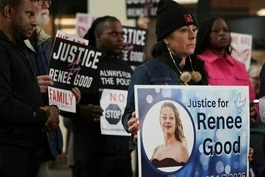
Protesters push for accountability after ICE shooting
Video has Closed Captions
Clip: 1/8/2026 | 6m 20s | Minnesota leaders and protesters push for accountability after ICE shooting (6m 20s)
Rep. Zinke on Trump, Maduro and war powers
Video has Closed Captions
Clip: 1/8/2026 | 8m 51s | Zinke supports Trump action in Venezuela but sees no basis for action in Greenland (8m 51s)
Senate moves to restrict military action in Venezuela
Video has Closed Captions
Clip: 1/8/2026 | 6m 6s | Senate moves to restrict Trump from taking further military action against Venezuela (6m 6s)

Trump invites Colombia's leader to White House
Video has Closed Captions
Clip: 1/8/2026 | 4m 41s | In turnaround from earlier threats, Trump invites Colombia's leader to the White House (4m 41s)
Trump's foreign focus a distraction, Sen. Slotkin says
Video has Closed Captions
Clip: 1/8/2026 | 7m 18s | Trump focused on foreign affairs to distract from domestic challenges, Sen. Slotkin says (7m 18s)
Providing Support for PBS.org
Learn Moreabout PBS online sponsorship
- News and Public Affairs

FRONTLINE is investigative journalism that questions, explains and changes our world.

- News and Public Affairs

Amanpour and Company features conversations with leaders and decision makers.












Support for PBS provided by:
Major corporate funding for the PBS News Hour is provided by BDO, BNSF, Consumer Cellular, American Cruise Lines, and Raymond James. Funding for the PBS NewsHour Weekend is provided by...