
Readers Club Episode 308
Season 2026 Episode 24 | 40m 24sVideo has Closed Captions
PBS Books Readers Club welcomes author Andy Weir to discuss his best-seller Project Hail Mary
PBS Books Readers Club welcomes author Andy Weir to discuss his best-selling sci-fi novel Project Hail Mary. Project Hail Mary is equal parts thrilling, clever, funny, and surprisingly tender. Dr. Grace's wry sense of humor, mixed with his self-deprecation, brings a light touch to a story that's ultimately very smart and suspenseful.
Problems playing video? | Closed Captioning Feedback
Problems playing video? | Closed Captioning Feedback
Readers Club Episode 308
Season 2026 Episode 24 | 40m 24sVideo has Closed Captions
PBS Books Readers Club welcomes author Andy Weir to discuss his best-selling sci-fi novel Project Hail Mary. Project Hail Mary is equal parts thrilling, clever, funny, and surprisingly tender. Dr. Grace's wry sense of humor, mixed with his self-deprecation, brings a light touch to a story that's ultimately very smart and suspenseful.
Problems playing video? | Closed Captioning Feedback
Where to Watch PBS Books
PBS Books is available to stream on pbs.org and the PBS app.
Providing Support for PBS.org
Learn Moreabout PBS online sponsorshipMore from This Collection
The PBS Books Readers Club is a monthly digital-first series that brings its members into conversations behind the stories of your favorite books & shows. You can watch the online on the PBS App, with extended interviews available for PBS members on PBS Passport.
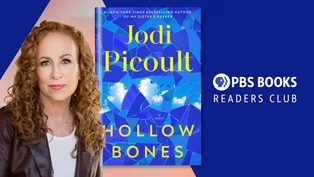
Readers Club Episode 309 Hollow Bones | Jodi Picoult
Video has Closed Captions
PBS Books Readers Club welcomes prolific author Jodi Picoult to discuss her newest novel (46m 12s)
Readers Club Episode 307: Booking It Across America
Video has Closed Captions
This month, PBS Books Readers Club celebrates America 250 with a special episode (15m 49s)
READERS CLUB Episode 306 : Our Favorite Books for Summer
Video has Closed Captions
Our hosts of the PBS Books Readers Club, share their perfect picks to binge beachside this summer (18m 45s)
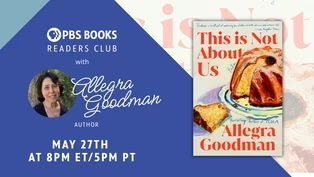
Readers Club 305: This Is Not About Us | Allegra Goodman
Video has Closed Captions
New York Times bestselling author Allegra Goodman of Sam and Isola to discuss her brand-new novel (36m 31s)
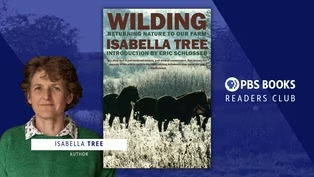
Readers Club 304: Wilding | Isabella Tree
Video has Closed Captions
PBS Books Readers Club welcomes British author and conservationist Isabella Tree (33m 17s)
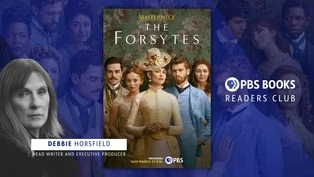
Readers Club- Debbie Horsfield | The Forsytes
Video has Closed Captions
The PBS Books Readers Club takes on John Galsworthy's classic novel series The Forsytes. (32m 36s)

Readers Club | 302 Book Picks for Black History Month with Lauren Smith and Princess Weekes
Video has Closed Captions
PBBS Books Readers Club recommend their favorite Black History Month reads. (16m 16s)
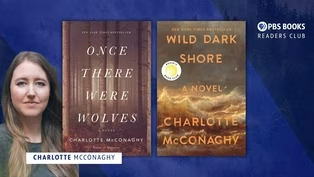
Readers Club | Ep 301: Charlotte McConaghy | Once There Were Wolves
Video has Closed Captions
PBS Books Readers Club hosts author Charlotte McConaghy to discuss her novel Once There Were Wolves. (58m 55s)
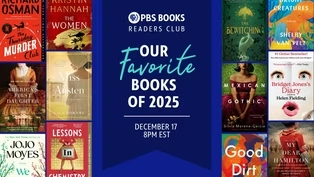
Readers Club | Ep. 212: Our Favorite Books of 2025
Video has Closed Captions
PBS Books Readers Club celebrates the wrap of its second season with a highlight of 2025 (47m 55s)
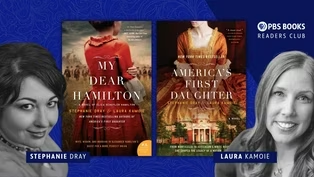
Readers Club | Ep. 211: America's First Daughter | Stephanie Dray & Laura Kamoie
Video has Closed Captions
PBS Books Readers Club welcomes co-authors Stephanie Dray and Laura Kamoie (1h 1m 45s)
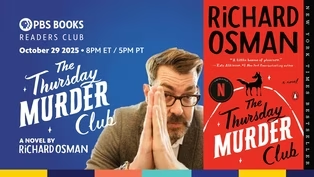
Wed Oct 29 2025 | Readers Club | Ep. 210: Richard Osman | Thursday Murder Club
Video has Closed Captions
PBS Books Readers Club welcomes celebrity writer Richard Osman to discuss his best-selling novel (52m 44s)
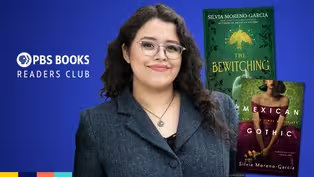
Readers Club | Ep. 209: Silvia Moreno-Garcia | The Bewitching and Mexican Gothic
Video has Closed Captions
PBS Books Readers Club welcomes award winning author Silvia Moreno-Garcia to discuss her new book. (52m 42s)
Providing Support for PBS.org
Learn Moreabout PBS online sponsorship(bright music) - In terms of where do I stop the science and start the story, I never stop the science.
I'm always doing that.
In the background, I'm always doing it, 'cause the research and the math and stuff like that, that's the stuff that's fun to me.
The pesky characters and crap that I have to throw in there to actually make it a book, that's like, "All right."
(bright music) - [Announcer] This program is brought to you in part by Libro.fm.
Libro.fm partners with more than 4,000 bookstores around the world to sell audio books, encouraging more people to read while supporting local independent bookstores.
- Hello and welcome to the PBS Books Readers Club.
Today we are excited to welcome Andy Weir, award-winning author of the bestseller-turned-blockbuster "Project Hail Mary."
When Dr.
Ryland Grace wakes up on a spaceship millions of miles from Earth, he has no memory of how he got there or even who he is.
He soon realizes he is the sole survivor of a mission designed to save the planet from a catastrophic threat.
As fragments of his memory return, Grace must use science, courage, and sheer determination to solve an impossible problem.
While doing so, he discovers he may not be as alone in the universe as he thought.
"Project Hail Mary" is suspenseful, smart, and so funny.
It's also unexpectedly heartwarming.
It's a story about perseverance, discovery, and the surprising bonds that can form when everything is on the line.
Have you had a chance to read "Project Hail Mary"?
I'd love to know what you thought about it in the chat or comments.
Also, have you read any of Andy Weir's other books and do you have a favorite?
I'm Lauren Smith, and joining us for our conversation with author Andy Weir is Princess Weekes.
Hey, Princess.
- Hi, I miss you so much.
- I miss you too.
It's great to have you back.
- It's so good to be back, and for a really incredible book.
- Yes, okay, so "Project Hail Mary," not our typical PBS Books pick.
I am so curious to know what you thought.
- Well, you know I'm a sci-fi girly, and I'm a second-generation Trekkie, so I just really loved all the fun science about it and making it come together and how it worked.
And I found that, I listened to the audiobook, and the narrator did such a good job of just taking you on the journey of the main character figuring out things, and so it didn't feel very info-dumpy.
It felt like you were learning things gradually and really feeling seated in this character as all these like really emotional, bittersweet things are happening, and it was really incredible.
And as someone who loves space in concept, I'm not going, it just reminded me of why investing in like space and science is so important, and how much we have to learn from up, up, up above.
- So, okay, I'm the opposite.
I hate space.
I hate space books.
I don't like space movies.
I'm not a sci-fi girl.
I love fantasy, but I don't like sci-fi.
I don't like robots.
Just the idea of no oxygen and pressure changes on the other side of a very thin wall, it causes me so much anxiety.
For that matter, I don't like submarines either.
- I was gonna say, you don't like oceans either.
(laughing) - This is not in my wheelhouse.
And so I had to pick a book that aligned with our PBS Summer of Space theme, and so I was like, "Oh man, like what am I gonna pick?"
And it was actually my brother and my dad who are huge fans of this book.
And they're like, "Lauren, trust me, like we know you, you're gonna love this book."
And so I picked it up and I was like, "Okay, fine.
Space book, here we go."
Within two pages, I was so into it 'cause it's so funny.
I was laughing out loud.
I never do that.
It was so funny.
And that's the part I love the most.
- Absolutely.
And it is so true.
It's very dad-coded, very big brother-coded.
- It was.
- And when I found out I was doing this interview and I told a guy that I was doing it, he was like, "Oh my God, I love those books."
And I'm like, "I know.
I love them too."
- So funny.
- But I just think it's so incredible.
And I think especially with this past year with the Artemis II, and everyone just kind of seeing space in this new, interesting way, I think it's just so beautiful.
Like, I agree with you.
It is scary.
That's why I'm not going.
But I think the human mind being able to figure out a way to be in that is amazing and something worth celebrating.
Like we did that, us, humans.
(chuckling) - And it kind of makes you feel like a kid again.
It's like, "Let's build a rocket ship out of a box and go to the moon."
Like just that level of creativity and imagination was so cool.
And I also loved just the human element of it.
Because he was thinking in his head all the things that like any human would think.
Like, "I don't want to look dumb in front of the aliens."
So funny and also like so true.
Like we humans, we care so much about what other people, other aliens think.
Like that's what would be going through all of our heads.
And I just, I loved his internal monologue.
And so the humor for me like saved the whole genre of space, and it's opened up a new galaxy for me.
- Incredible.
No, I agree.
The humor was so great, and it made me think about, yeah, I do often wonder what our sort of the evidence of us will be like in like 10, 20 years.
And I think what was also great is to have a protagonist who, the more you learn about them, the more invested.
I think one of the best moments is when you realize why he decides to take on the mission, like this genuine care for the future generations.
And I just thought, "We need more of that."
We need more of people not just thinking about the now, but the future.
- Yeah, the idea of bravery and courage and what that takes, I am excited to get into that with the author.
And Andy Weir is standing by to join us in just a moment, so we're excited to talk to him, but first, don't forget that PBS Books and everything you love about PBS relies on support from viewers just like you.
So please, if you have a minute, go to pbsbooks.org and make a donation so that we can keep bringing you these amazing book talks and author conversations.
We've got some fun ways to say thank you too.
We've got the PBS Books mug.
On the back it says, "My weekend is booked."
I'm sure that yours is, just like mine always is.
And we also have the PBS Books Readers Club book bag.
It's so cute.
I don't know.
There's probably four or five books in here right now.
It's kind of heavy.
It fits a lot.
It's very cute.
Crossbody bag.
You can take it everywhere.
So we really appreciate your support.
If you go to pbsbooks.org/donate, you'll be taken to your local station's donation page so you can search for the gifts and support your local station.
So we thank you so much for that.
And we also encourage you, if you love the book "Project Hail Mary," and you're interested in this space theme, there are some really cool shows on the PBS app right now.
One of them is called "Once Upon a Time in Space."
It's another really interesting space documentary drawing on intimate, unseen archival materials and powerful firsthand testimonies.
It's a landmark four-part series that tells the human stories behind our quest to explore space.
There's also a really cool episode of "Nova."
It's called "Nova: Return to the Moon."
They follow four members of the Artemis II crew as they embark on a perilous 10-day journey to orbit the moon, venturing beyond Earth orbit for the first time since Apollo and further into the solar system than any humans have gone before.
You can find all of those to stream on the PBS app right now.
And now let's turn the page to our author conversation with Andy Weir, author of "Project Hail Mary" and many others.
Andy, thanks so much for joining us.
- Thanks for having me.
- How exciting.
- [Lauren] So Andy, you like space, huh?
- A little bit.
- Yeah, we can tell.
Give us a little bit of the backstory of "Project Hail Mary" for those that haven't read it, a little description, and also just what inspired you to write it.
- Well, I'll start with a little description.
Just the elevator pitch is an extraterrestrial like microbe, like a single-celled organism is breeding out of control on the surface of the Sun, causing it to dim, and that's happening to all the stars in the local area, and except for one, Tau Ceti, and so humanity builds a ship to go to Tau Ceti and find out why.
What led me to the story was I always wanted to... I was speculating on what we could do, humanity, if we had a mass conversion-based fuel, not like 1,000 years from now, but like right now, like people with modern day, and I was initially thinking like, "Well, you know, if we had that, we could colonize the solar system really easily."
And I'm talking about, it would be neat to have like modern day like society, but suddenly like interplanetary culture.
I mean, it's like Britney Spears fans on Mars, you know?
It's not like in some unknowable future, you know?
And I was thinking, "Wow, there's a lot we could do with that.
We can do that."
And then I started thinking, "But how do they get a mass conversion-based fuel?"
'Cause that's a pretty big technological leap.
I could say that some scientists invent it, but that's a bit much for me.
I could say we find it in a wrecked alien spaceship, but then that makes people just ask about the aliens, and also be of limited supply.
And so then I came up with this idea of like, well, what if it's like they find it in a wrecked alien spaceship and it can make more of itself?
So if you shine light on it or something like that, it'll make more of itself.
So it absorbs energy and then releases energy as like a rechargeable battery almost.
And I'm like, "Okay, that's cool.
But wait a minute, this is now something that absorbs energy and then makes more of itself.
That sounds like life."
And I'm like, "Okay, so let's go backwards.
Let's say there's some extraterrestrial microbe that can travel interstellar distances."
Well, why?
Well, to travel interstellar distances, it would need to live on the surface of a star to get that much energy to do the mass conversion.
Okay, well, then I guess it's like a mold that is on stars and spores out to other stars.
And I'm like, "Okay, so there's my explanation of how we get some.
Now I'm gonna make this interplanetary, you know, society and stuff like that."
In the back of my mind, I was like, "Oh, we'd have to make sure we don't let any of that crap get on our star, 'cause that would be a disaster."
And then after a few seconds, I'm like, "Okay, no, no, that's the story.
Okay, that's obviously the story."
- After a few seconds.
- Exactly.
- [Lauren] So it took you like 90 seconds to build out the plot of the book?
Is that what I'm hearing?
- Well, basically at that point it becomes self-evident.
It's like, "Oh, yeah, a microbe is reducing the solar output that will spell doom for Earth.
We need to find a way to keep that from happening."
And the rest of it came pretty quickly.
I was like, "Well, wherever it's from, it's probably in balance there," and so on.
- [Princess] That's such a cool concept.
It's like "The Thing" turned into a hard science thriller.
What I found so interesting about the book was the choice of having the character have amnesia at the beginning and taking that approach of sharing that exposition that way.
How did you develop that balance between having the character figuring out things as we go along, but also letting us know who they are?
- Cheesy flashback trope.
Simple as that.
I mean, it's as simple as that.
The problem is that I had the whole story in my mind kind of roughly laid out before I even started page one.
In fact, I knew what the last scene was gonna be before I wrote the first word, right?
So I'm like, "Okay.
I know I've got this laid out," which is a lot more than usual when I'm writing a book.
Usually I'm like, "I don't know where the hell this is gonna go."
I'm not exactly a full-on answer like George R. R. Martin, but I have like, "This big thing happens, this big thing happens, this big thing happens, here's the end.
I don't know how the hell we get from point A to point B. Let's find out."
In this case, I was like, "Okay, here's all the things that have to happen to make this story work."
But if I told it linearly, it would be really unsatisfying, because it'd be like all these characters, like, you know, Stratt and Dimitri and all the Earthside characters would just be there in the first act and then never again.
That would be it.
After the launch of the Hail Mary, you'd never see them again.
'Cause if I was doing a purely linear story arc... - [Lauren] That's a lot of alone time for one guy.
- Exactly.
- Right.
Well, and then not only that, but then I don't end up introducing Rocky until almost the halfway point of the book, you know, if I did it that way.
I mean, Rocky I knew would be like when people really start getting invested in reading it, and so I wanted that to be as early as possible.
I wanted that to be front-loaded.
And so I'm like, "Do I want to be the cheesy author who just uses flashbacks?"
Yes.
Yes, I do.
- Yes, I do.
- And so... - It works for a reason.
- Yeah, I did the amnesia thing because, you know, I have my explanation for why he has amnesia, which we learn toward the end of the book.
It was actually like deliberate.
But I wanted to tell it in a flashback narrative, so I kind of set up the present day as a framing device for the past initially, and things spur his memories as he's getting his memory back.
That way he's experiencing the flashbacks at the same time you are.
So it's a little different in the movie, but in the book, he doesn't know anything you don't know as you're reading the present tense statement.
As you're going through the book, you know, he's not keeping any information from you.
He's remembering it as you see those flashbacks.
- [Princess] Well, as you mentioned, Rocky is such a compelling part of the story, and you invented an alien species, which is so cool.
How did you land on the final creation of this world?
Did you have any other fun concepts along the way that got discarded or reworked into something else?
- Not really.
So what I did was I started with the exoplanet that I'd picked for him to be from, 40 Eridani A b, which at the time was thought to be an exoplanet that weighed about eight times the mass of Earth and orbited 40 Eridani, the star, about once every 46 days and stuff like that.
Since then, we've learned that it doesn't exist at all.
Oh, well.
- Shoot.
- But it's fiction.
At the time, I used what was known about the planet, and then I got to make up the rest.
And so I'm like, "Okay, so now what do I know about this planet?"
It's got oceans, and it's got a really thick atmosphere.
And I said, "It's got such a thick atmosphere, in fact, I don't think light would make it to the bottom."
And so I came up with this biosphere that basically works like an ocean.
And so then I'm like, "Okay, so that explains the biosphere.
What about the actual species?"
I'm like, "Well, there's no light, so they don't need eyes."
And, you know, I worked from there, that sort of thing.
And I had fun with that.
I wrote a whole document on it.
It's posted online for people to see how their muscles work, how their reproduction works.
- Oh, that's cool.
- How everything works.
- [Princess] That's awesome.
- We'll have to link to that.
That's really cool.
'Cause I was curious if there was anything that you could tell us about the lore of Eridians, about their culture, or maybe something about their physiology that you know but maybe didn't need to make it to the book.
- Tons, tons of stuff about their physiology, but nothing about their culture.
I really did not invent much about their culture, because you're only on Erid at the very, very end of the book, and I'm like, "I don't want to have to make up an entire planet's history and culture and stuff like that for the three pages that we're gonna be there, and I don't want to have to exposition that all to the reader."
- [Princess] And you've done a lot of work already, you know?
(laughing) - It could be a whole other book.
Just, yeah, the world building of it all fascinates me.
- [Princess] I think, if you don't mind me following up, Lauren, I think when I was reading your book, I was so engrossed in everything.
My little bit of astronomy, I could understand a little bit of what you said.
At what point when you're building a world does the science and the base of it stop and the story begins?
Like when do you know like, "Okay, I think I've done enough for at least this part of the book.
Let me actually keep going"?
- Well, on the research... - How much of it is legit?
'Cause like listening to you, I feel like you'd be a great science teacher.
And I feel like it all, to me, it all seemed to check out.
- Yeah, you actually have to dig down to the quantum level to find the BS in the story of "Project Hail Mary."
But so, and I'll explain that in a minute, but in terms of where do I stop the science and start the story, I never stop the science.
I'm always doing that.
In the background, I'm always doing it, 'cause the research and the math and stuff like that, that's the stuff that's fun to me.
The pesky characters and crap that I have to throw in there to actually make it a book, that's like, "All right."
And so... - [Princess] If you must have characters.
- Yeah, I guess so.
- You could write textbooks.
- I can't just make a giant Wikipedia article.
Like, "Wouldn't this be cool?
The end."
Now, so I have to do all that, but I'm always doing the research.
I'm always thinking of things like 5 to 10% of all the stuff I math out or come up with ends up in the book, so that's a real challenge for me is paring it down to be like, "I don't want this to read like a textbook."
I want the reader to be pulled along and enjoy it and get invested in characters and all that stuff like that.
So I want to minimize how much I explain it to them.
And one thing I've found is I've got two things working for me.
One, I don't need the reader to pass a test after this.
I just need to make them understand that this is a thing that happens.
Like relativity.
It's a thing that happens.
I don't expect the reader to be able to tell me, you know, what the time dilation ratio is for a given velocity at the end.
They just need to understand that it's a thing that happens.
And then so what's really cool is I don't need to explain it enough to make them really understand everything.
I just need to explain it enough to make them think they understand it, and then they're happy with the story.
The other thing is my readers, for whatever reason, have come to really trust me.
I learned this a lot from a lot of people who say like, "Yeah, I'm not scientifically minded at all.
I'm not really interested in it.
So when you explain things in science, I just kind of like, 'Yeah, I'm sure that's right,' and then onward."
You know, but that level of trust from a reader is fantastic.
It means their suspension of disbelief is perfectly intact.
They're like, "Yep, I'm good with that."
- And you said you don't really like to write the pesky characters, but your characters are so good.
- Thank you.
I do like characters.
- I love the character of Grace.
Speaking to you, I kind of feel like there's a little bit of you in him, just in the way that you like to figure things out and get excited about science.
I love that element to him.
But I also was curious about just this concept of cowardice versus bravery and the journey that he goes on.
His name is Grace.
Like I think, how does that all intersect, and how did that journey sort of move forward for you?
- Well, frankly, his name is Grace because I couldn't resist the pun.
The Hail Mary is full of Grace.
- Yeah.
- Too good.
- That's all.
Nothing deeper.
Yeah, I wanted to make a hero that wasn't like a traditional standard hero.
I wanted that big reveal at the end that he did not volunteer for this.
He was forced on it, and then he kind of has his character growth because he finally has somebody he cares about in his life so much that he's willing to risk or even sacrifice his life for.
You know, it's a bromance, bromantic comedy.
- Do you think that is sort of true of humans in general?
Like do you think that bravery requires you to have someone worth sacrificing for as sort of a human trait?
And would you go?
- Someone or something, right?
I mean, some people, I mean, lots of people would be willing to sacrifice themselves for another person.
I have a five-year-old son.
I wouldn't even think twice.
If I had to pick between me or him, I'd die instantly.
Other people are willing to die for a cause, or their country, or people.
I mean, your life is very, very valuable, but there are things that are more important to you than that, I think, for everybody.
And I'm not some hero guy.
I just, there are things in my life that are more important to me than my life.
Probably the same for you ladies, especially if either of you have kids.
- [Lauren] Yep, an eight-year-old and five-year-old at home, and just the same, yep.
But is it someone in... - [Andy] Well, and see, you don't look old enough to have kids that age.
- Well, thank you.
You're my new best friend, Andy.
But yeah, I mean, I thought that was an interesting thing about Grace and the storyline was that he wasn't brave enough to sacrifice himself until he met this character, Rocky, and then he was.
And I just thought that that was really interesting, that sort of change in his heart.
- Yeah, so Grace was the first time I made a character from whole cloth and came up with a growth arc for him, and I didn't just make him based on my own personality.
Of course, you always have some... - [Lauren] There's some similarities.
(chuckling) - But like Watney from "The Martian," Mark Watney is just me, straight up me, with all of my bad parts deleted and all of my good parts magnified.
Kind of funny.
He's really funny.
- That's the way to write.
- I'm kind of smart.
He's really smart.
Mark Watney is not afraid of flying, but I am.
- Same.
- I take drugs to fly.
And, I mean, prescribed by a doctor, let's be clear.
But yeah, so he's the idealized version of me, but he's just me.
And "Artemis," also known as Andy Weir's other book, is... - [Princess] I've read it.
- Thank you.
The main character, Jazz Bashara, is a 26-year-old Saudi-descended woman who grew up on the Moon.
She's also me.
You wouldn't think that, but she is.
She's just exactly the way I was when I was her age.
Immature for my age, my own worst enemy, theoretically smart, but making really bad life decisions.
She is also based on me, which is kind of hard to see when you look at the outside of her, but, you know, the inside, same thing.
And so for Grace, I'm like, "Well, I don't want to make another me, so I'm gonna make somebody new."
And that's what I did.
- [Princess] That's awesome.
- [Lauren] Well, okay, I'm sorry, but he sounds a little bit like you.
Just the way, talking to you, your voice is the voice that I heard.
- Yeah.
I can't help it.
All my characters are gonna be a little bit like me.
I freely acknowledge that character depth and complexity is my greatest weakness in my opinion, and that's what, I'm always working on it.
I want to get better at it.
But yeah, I think I'm pretty good at making intricate and interesting plots, but I'm weak on, you know, comparatively weak on making, you know, characters with depth, complexity.
So that's what I'm working on.
- [Princess] So you dedicate this book to the great Paul, John, George, and Ringo, and The Beatles.
Was this your own personal taste, or was it tied to "Across the Universe"?
Do you just think that The Beatles is the best thing that we ever did music-wise?
- Yeah, yeah.
They're my favorite band of all time by far.
Love them.
And I don't know, every now and then, I just started putting Beatles references into the story and it just kept rolling.
It started out because the ship has those four spaceships to send back information, and I actually designed like the spaceship, and it has this little big bulbous area to hold fuel and then a little sensor node at the top.
And I'm like, "It looks like a beetle, so I'm going to call it a beetle."
And then I'm like, "Okay, well, if you're going to have something called a beetle and you have several of them, you're gonna have four, and you're gonna name them John, Paul, George, and Ringo."
I mean, that's obvious.
And then the Beatles references just kept coming.
And so I've said this before publicly, but you can find the titles of every Beatles album in the text of the book.
- [Lauren] Oh!
- Princess] Oh, that's cool.
- [Lauren] A little fun project for us all.
- [Andy] A little scavenger hunt for you.
- They won't be... - That's so cool.
- There are 13 Beatles albums, so not the compilations, not like 62, you know, not 60, 64, whatever.
Not the compilations, not anthology, not, you know, any sort of best of, but the actual original content albums.
And then they will be in the text phonetically, but not necessarily spelled the same.
- Okay.
Got it.
Okay, so right after this interview, I'm gonna call my little brother, Chuck, because he's the one that recommended this book to me.
He's a huge music fan.
And he gave me some questions that he wanted me to ask, but he's gonna love this little project that you just designed.
- I'll give you one example.
I'll give you one for free.
There's a flashback where he's in his classroom, There's a flashback where he's in his classroom, and one of the students is named Abby.
And she asks if horses are gonna be okay in the coming climate apocalypse, and the narrator says, "Abby rode horses and wanted everyone to know it."
- Got it.
- Got it.
- [Lauren] Okay.
- [Andy] So they're snuck in like that.
- That's super fun.
- That's so clever.
- [Lauren] I love that.
- So it's phonetically there.
You can't just search.
You can't just search for the album names.
- Nope, nope.
We're gonna dig in.
This is gonna be my project for when I'm bored, which doesn't happen a lot, but I will just keep the book with me at all times.
Okay, so this is my question from my brother.
I promised him I would ask it 'cause he's your biggest fan.
He loves all of your books.
He saw the movie the first day it came out.
I have to credit him with introducing me to space and sci-fi, because generally I was like, "Space is scary and I don't like it."
But I love your book, and so I have him to thank for that.
But he wanted to know... - [Andy] Westeros is scary, but I still like the stories.
I wouldn't go there.
- [Lauren] So the question is, the characters in your book, from "The Martian" or "Project Hail Mary," who did the character better justice, Matt Damon or Ryan Gosling?
- [Andy] Oh, come on, man.
- [Lauren] And I can ask you that comfortably, 'cause I know they're not, they haven't found my show yet.
They're not watching.
They're not gonna see it.
I promise no one will find out.
- [Princess] It's just between the PBS fans.
- [Andy] Let me ask you, which one of your two kids do you love more?
- [Lauren] Okay, that's a good answer.
- Don't worry.
They haven't found your show yet.
(Lauren and Princess laughing) I can't answer that.
They both did a fantastic job.
I know this sounds like a fluff answer, but I genuinely don't have an answer, because they both absolutely nailed their respective characters.
Your brother's question is a trap.
Tell him he's bad.
- [Lauren] It is.
It is.
Well, thank you.
You gave a beautiful answer.
- [Andy] Tell him he's bad and he should feel bad.
- [Lauren] I will.
- [Princess] That's a bullet for a millennial man.
Well, I would ask, is... - Tell him the best actor that encapsulated one of my characters is James Ortiz.
- Okay.
(chuckles) - There we go.
If you had the chance to be part of a space expedition, would you want to do it or would you be reluctant?
Oh, that's your vice.
- Just a hard pass.
No, I write about brave people.
I'm not one of them.
I need to take... - [Lauren] So you wouldn't go to space if it was like to save, you know, not to save the world, just a comfy space tourism trip, free trip.
You're not going.
- [Andy] Nope.
Nope.
I'd give my ticket to you if you're into it.
You go.
- [Lauren] Nope, pass.
Hard pass from me.
- [Andy] Okay.
See, there you go.
Yeah.
How about Princess?
- [Princess] Only if it's like Barsoom, and it's gonna be like really cool with really like fun alien people.
- [Andy] Oh no, hold on a minute.
If I can magically teleport to another planet and it has like an Earth-like atmosphere, then sure.
But get on a rocket and... - Oh no, I'm not doing that.
- No.
Hell no.
- [Princess] No.
I'm ride or die for the earth.
I'm staying here.
- Yeah, no.
Same here.
Like I said earlier, I need to take like medicine just to be able to get on a plane, so unless you have an anesthesiologist to put me under for the trip... - [Lauren] You need the coma.
You need the induced coma.
- Yeah, exactly.
- Exactly.
Just wake up, be like, "We're here," and then go right back to sleep.
- No, I'd still be terrified even if I somehow managed to not have to experience the trip.
Just being on a space station would terrify me.
I'm like, "That's vacuum out there.
That's death.
Death is right out there."
Like death.
- 100% with you.
- Both feet for me is death.
- Absolutely.
- Oh my gosh.
Okay, I could talk to you all day.
We just have a couple more questions.
Did you always know that you were a writer, or was it more of like a space, science, math thing that like transitioned into writing?
Like what's your writer's journey?
- Well, I always wanted to be a writer.
I always loved science fiction.
I loved reading it.
I grew up with my dad's sci-fi collection, which was like this six-foot tall, three-foot wide bookshelf, jam-packed full of paperbacks that he read when he was a kid.
So I grew up reading boomer era sci-fi, which was back when it was much more hopeful and stuff like that, which is kind of how I write, as opposed to this bleak dystopia stuff that happens now where the world sucks and only teenagers doing weird (beep) can save it.
And so, but yeah, so I grew up with that.
I mean, I was writing short stories and stuff when I was a tween, but when the time came to go to college, you know, I decided... I was also really into computers, like programming them, 'cause you may not have noticed this, but I'm a little bit of a nerd, so I was pretty solid with computers and I liked that.
And I was like, "Okay, so I can either go for..." You know, it's college.
It's time for me to make up my mind.
I can either go for computer science or I can go for writing.
And I decided between the two I liked regular meals, so I went for computer programming.
But I was always writing on the side for fun.
Later on in life I took a three-year sabbatical to write a book.
Didn't get that published either.
So I paid my dues, you know, along the way.
- [Princess] What is your ideal writing setup?
Are you a morning person, night owl?
Do you need total silence?
What's your routine like?
- Well, I need solitude.
I need like nobody in the room, for two reasons.
First off, I need to not be distracted.
Second off, anyone watching me write would think I'm schizophrenic, because I say the dialogue out loud, and so sometimes I'll have animated, angry conversations with myself, you know, being the characters who are having a talk to find out what works well and flows well and how to make the conversation go the way I want.
So anyone watching me would think, I mean, "That man needs help."
Also I need to be in a different physical building than my son, otherwise, it's like, you know, knock, knock, knock, "Daddy," knock, knock, knock, "Daddy, Daddy, Daddy."
You know, so I have to be somewhere other than him.
- [Lauren] I get that.
I get that.
- [Andy] I love the guy but I'm definitely not getting work.
- Summer's the worst.
- Yeah.
If he's around.
And yeah, other than that, I don't need silence, but I do need, if I'm gonna play some music, which I do sometimes, it needs to have no lyrics.
It needs to be instrumental, 'cause it, you know, soaks up my, you know, whatever, language center to be hearing lyrics in the background.
I can't focus on the writing.
- So you're also, you're a big science fiction person.
I'd love to know, like if you have any books that you would recommend to people like me.
I haven't been a sci-fi person until I read your book, and so now it's opened up a new universe of potential books for me to read.
So are there books that you would recommend that people like me should give a try?
And also, are you working on anything new right now that we should be looking out for?
- Well, I'll answer them in reverse order.
Yes, I'm working on my next book now.
It's gonna be a while before it's on shelves.
I mean... - [Lauren] Okay, okay.
Well, let us know.
- Yeah, I'm like about 50,000 words into it, so like somewhere between a third and a half, and yeah, somewhere in that range.
- [Lauren] All right.
Keep it up.
- A lot of writing yet to do on that.
I'm not talking about details of that publicly other than to say it's science fiction, of course, and it's another standalone story.
It's not a sequel to anything.
It's a new, unique story.
- [Lauren] Cool.
- As for recommendations, well, different folks, different strokes, right?
So if you're okay with the technology and maybe even the social context being a little out of date, I do recommend my holy trinity of authors, Asimov, Heinlein, and Clarke.
Now, when you read them for... - [Princess] I have all of those, so I can lend them to you, Lauren.
- Okay.
- Thanks, Princess.
- When you read them now in a modern context, there's some sexism.
There's some stuff in there that wouldn't fly in modern day, but if you read it within the context from which it was written, they're really good books.
If you want more modern stuff, I highly recommend Blake Crouch.
Most people's favorite book of his is "Dark Matter," which was made into like a, I think, Apple TV series.
Forgive me if I'm wrong on that, but it was made into a streaming show.
It's very good.
But my personal favorite is "Recursion," which is a different book that he wrote.
It's about time travel and it's really cool.
- [Lauren] So that's the one that if you were going into the coma to go onto the spaceship, that's the one book you would take with you if you were forced onto a ship.
- Well, for me, I know my sensibilities and the things I like.
Well, I would take probably "I, Robot," by Isaac Asimov.
- [Princess] Oh, that's a great one.
- And if I'm gonna recommend one from each of my holy trinity, I'd go "I, Robot"... Well, actually, no.
So I love "I, Robot," but if I was gonna recommend to the general public at large to get some Asimov into your life, I would start with "Caves of Steel," because that is in the Three Laws of Robotics universe, but it's the first in a series of books with a consistent set of characters, and so it's fun to read, 'cause if you like it, you can move on to the next one and the next one and so on.
For Robert Heinlein, I would say "Tunnel in the Sky."
It's a good survival book, good survival story about people versus the elements.
And then for Arthur C. Clarke, who famously wrote "2001," I like "Rendezvous with Rama," which is a real cool kind of sort of first contact story.
It's really interesting.
- [Lauren] Okay, I've written these all down, and I'm adding them to my list, so thank you.
- Okay.
- [Lauren] All right, Andy, I got one more question for you, and then we will let you go and write this new book that you're working on.
For other aspiring writers, maybe particularly in the sci-fi space, do you have any advice, or maybe someone gave you some advice along the way that you might want to share?
- Well, I have advice, 'cause I get asked that a lot.
I have three bits of advice for anyone who wants to start writing.
Number one is you have to write to be a writer.
You can sit there and ideate and think about plot lines and backstory and world building and stuff all you want, but until you're actually writing, you're not writing.
It's when you first start putting words on the page that you realize all the problems.
Like you're like, "Okay, I've got this whole story.
I got it all worked out.
Oh, crap.
How am I gonna explain the previous 500 years of history in the story that led to the moment that I wanted to start talking about?
Aw, crap."
You know, that's when you start finding out.
So in order to write, you have to actually write.
That's number one.
Number two, this is hard, resist the urge to tell your friends and family about your story.
You can tell them a vague plot outline, but don't give them details, because most writers are driven by a desire to have an audience experience their story, so if you tell your friends or family about it, then that satisfies that need.
You've satisfied your desire to tell that story to someone, and that saps your will to actually write it.
So what you should do is make a rule that says the only way anyone experiences this story is by reading it.
So you can still give your friends like a chapter at a time or something like that if you want some intermediate feedback and external validation that you crave, but don't just tell it verbally.
And the third one is there's never been a better time in all of human history to self-publish.
Seriously, like since the Gutenberg press to today, there has never been a better time to wing it on your own.
I do recommend you try to get a traditional publisher first, which usually means you have to try to get an agent, which can be a real challenge, but traditional publishers, I definitely am gonna keep doing it that way.
Traditional publishers are great because they're a marketing and publicity engine for your book.
They get it into the hands of book reviewers.
They do all the things to put your book out there and make more people aware of it and to encourage them to read it.
But if you can't, you can self-publish, and it costs literally nothing.
It's like you can post it online as an ebook.
Amazon, Barnes & Noble, there are several services that do it.
They don't charge any upfront fees at all.
They just charge a percentage of your cover price.
That's it.
I mean, that's how "The Martian" got started.
- Okay.
- Awesome.
Thank you.
- [Lauren] Well, that second piece of advice, I've never heard that and I think it's genius.
- [Princess] I know.
That was really good.
- [Lauren] So thank you for sharing that.
- [Andy] That one's unique to me.
I think I came up with that one.
- Okay.
- Okay.
Awesome.
Well, Andy, thank you so much for joining us today.
This was the most fun I've had in a long time.
- Thank you.
- Hey, fist my bump.
- Fist your bump.
Nope, that's still not right.
- Thank you, Andy.
- All right.
Bye-bye.
- Okay.
That was so much fun.
- Ah, that was like the perfect kind of interview.
I'm so happy that we were here for this.
So funny, so interesting.
And my brain, when he was describing all of the different science that came into it.
I took one astronomy class in college, which was basically physics.
And I was like, "Okay.
Uh-huh, uh-huh."
But it was great.
It felt so natural.
It was wonderful.
- Seriously, I'm inspired to tackle this whole new genre of sci-fi and space, and I'm glad that he gave us some recommendations.
And I will be borrowing your copies.
So thank you for that.
- I'll bring them next time.
Also, those Beatles references.
- Oh, yeah.
- We have to find them.
Well, we can have the boys in our lives that love the Beatles find them.
- Yes.
Well, okay.
So our, you know, viewers, readers, PBS Books members, let's hear from you.
Like please go through the book and see what you can find.
Like give us a little cheat code in the comments.
If you found some, let us know.
- We helped you with one.
You gotta help us now.
- That's right.
Yes, give us a hand.
Okay, Princess, thank you so much for joining me.
This was so much fun.
I miss you.
It was great to talk about books with you once again.
- Thank you so much for having me.
It's always a pleasure to get to see you.
I miss you so much.
- And thank you for joining us.
I'd love to know what your favorite part of the interview was.
And if you like stories about space, then enjoy more Summer of Space with our watchalikes, "Nova: Return to the Moon," and "Once Upon a Time in Space."
You can check those out on the PBS app.
And for even more great book recommendations, join the PBS Books Readers Club Facebook group, subscribe to our newsletter, and watch full author interviews on our YouTube channel.
And remember that this program only happens with your support, so please visit pbsbooks.org/donate to give right now and enjoy some of our great thank you gifts, including the mug or the PBS Books Readers Club book bag.
We will see you next time.
Thank you so much for being a part of the PBS Books Readers Club.
(bright music) (bright music continues) - [Announcer] This program is brought to you in part by Libro.fm.
Libro.fm partners with more than 4,000 bookstores around the world to sell audiobooks, encouraging more people to read while supporting local independent bookstores.









Support for PBS provided by: