
Tressie McMillan Cottom joins Geoff Bennett on ‘Settle In’
Clip: 1/26/2026 | 5m 13sVideo has Closed Captions
Tressie McMillan Cottom joins Geoff Bennett for our ‘Settle In’ podcast
For our podcast “Settle In,” Geoff Bennett spoke with University of North Carolina sociologist and New York Times columnist Tressie McMillan Cottom. They explored what's caused a loss of trust in institutions, what the Trump administration has revealed about the way power works in this country and how to find hope during the onslaught of difficult daily news.
Problems playing video? | Closed Captioning Feedback
Problems playing video? | Closed Captioning Feedback
Major corporate funding for the PBS News Hour is provided by BDO, BNSF, Consumer Cellular, American Cruise Lines, and Raymond James. Funding for the PBS NewsHour Weekend is provided by...
Support provided by:

Tressie McMillan Cottom joins Geoff Bennett on ‘Settle In’
Clip: 1/26/2026 | 5m 13sVideo has Closed Captions
For our podcast “Settle In,” Geoff Bennett spoke with University of North Carolina sociologist and New York Times columnist Tressie McMillan Cottom. They explored what's caused a loss of trust in institutions, what the Trump administration has revealed about the way power works in this country and how to find hope during the onslaught of difficult daily news.
Problems playing video? | Closed Captioning Feedback
How to Watch PBS News Hour
PBS News Hour is available to stream on pbs.org and the free PBS App, available on iPhone, Apple TV, Android TV, Android smartphones, Amazon Fire TV, Amazon Fire Tablet, Roku, Samsung Smart TV, and Vizio.
Providing Support for PBS.org
Learn Moreabout PBS online sponsorshipAMNA NAWAZ: We turn now to our PBS News podcast "Settle In."
In the latest episode, we explore what's caused a loss of trust in institutions, what the Trump administration has revealed about the way power works in this country, and how to find hope during the onslaught of difficult daily news.
GEOFF BENNETT: I recently spoke about all of this with the University of North Carolina Professor and New York Times columnist Tressie McMillan Cottom.
Here's an excerpt.
How much of our political dysfunction is actually an attention problem?
And how much has the media economy reshaped what kinds of stories and people get rewarded?
TRESSIE MCMILLAN COTTOM, The New York Times: Yes, I think there is something to the fact that obviously our attention has been monetized in a way that is really antithetical to how human curiosity has worked for millennia.
But I do think we overstate that fact, because it kind of sounds like, when you start talking about so many things are competing for our attention, and so we just can't capture people long enough to tell them what matters, right, and to move them politically, I think it's a bit of a cop-out, right?
It is true that it is hard to compete with TikTok and it is difficult to compete with memes.
And it is absolutely true that the media ecosystem now rewards the production of cheap, emotion-driven content over meaningful information and news.
But it is also the case that that is not naturally occurring.
That too was a political choice.
It is a political choice not to regulate technology companies.
It was a political choice.
I would point out that both the Democrats and the Republicans have had an opportunity to do and have failed to do so.
No one has shown a political appetite, real, strong political appetite for regulating technology companies, because at the root of that is what I would argue is the real problem, which is extreme wealth inequality and the extent to which money has infiltrated the -- our systems of governance and certainly campaign financing.
And so we have been willing to cede our attention in the name of money, but that was a political choice.
And now we find ourselves reckoning with the fact that attention cannot be captured long enough to tell people the truth, the objective truth, about what is happening to them.
But that is, again, a lesson about what happens when one side has more power than the other.
I don't think that is a foregone conclusion, however.
It is absolutely a political choice to say that our media ecosystem needs to have a civic core to it, right?
It is not a foregone conclusion that we all need to just accept artificial intelligence is here and we need to turn over our privacy and our citizenship rights to it.
Those are choices, right?
And I think that, when we focus too much on whether or not people spend too much time on TikTok, it lets a lot of political actors off the hook.
GEOFF BENNETT: Amid this sense of exhaustion, what does renewal look like, when it's not that people are apathetic?
It's just that people are tired.
They're worn out.
TRESSIE MCMILLAN COTTOM: Yes, there is a lot of exhaustion.
I would argue, though, that much in the way that we sort of have misconstrued the idea of taking care of ourselves and taking care of each other, as, you know, self-care, solve your problems with a bubble bath, we kind of have that problem writ large with politics, right, that if you are exhausted and overwhelmed by the onslaught of negative news, that you sort of need to retreat, right, and you need to withdraw.
When, in fact, everything from research to history to art will tell you it's the exact opposite, that sometimes we aren't exhausted because we are aware of too much.
We are exhausted because we are doing too little.
The antidote, I think, to political exhaustion, the type that we are talking about is that we are getting so much passive information and we have so few opportunities to act.
We are tired then not from doing too much, but from doing too little.
People who feel agentic aren't as tired.
They are not as easily overwhelmed.
So, if you are exhausted by the onslaught of bad news, go to a protest.
If you are exhausted by social policy that is demonizing children, start teaching children how to read.
The more time you spend doing something, whatever it is possible for you to do in your space in the world, the less exhausted you are by the onslaught of information that really wins when it can convince you that the only thing you can do is watch what is happening to you.
GEOFF BENNETT: And you can find that full conversation and all episodes of "Settle In" from PBS News on our YouTube page and wherever you get your podcasts.
Border Patrol 'untrained' for urban areas, ex-CBP head says
Video has Closed Captions
Clip: 1/26/2026 | 6m 14s | Border Patrol 'untrained and unskilled' for policing in urban areas, ex-CBP head says (6m 14s)

Democrats vow to block DHS funding after Minnesota shooting
Video has Closed Captions
Clip: 1/26/2026 | 3m 6s | Democrats vow to block Homeland Security funding after Minnesota shooting (3m 6s)
Judge hears Minnesota's arguments for ending ICE surge
Video has Closed Captions
Clip: 1/26/2026 | 5m 16s | Federal judge hears Minnesota's arguments for ending ICE surge (5m 16s)
Sadness, anger grip Twin Cities after latest killing
Video has Closed Captions
Clip: 1/26/2026 | 7m | Sadness, anger and exhaustion grip Twin Cities after latest killing by federal agents (7m)
Sen. Smith calls for 'meaningful restraint' of agents
Video has Closed Captions
Clip: 1/26/2026 | 5m 33s | Minnesota Sen. Tina Smith calls for 'meaningful restraint' of 'lawless' federal agents (5m 33s)
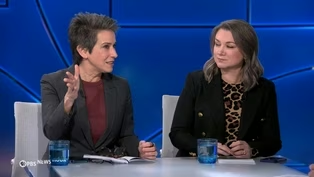
Tamara Keith and Amy Walter on Trump losing support
Video has Closed Captions
Clip: 1/26/2026 | 7m 39s | Tamara Keith and Amy Walter on Trump losing support over his immigration crackdown (7m 39s)

Thousands without power in aftermath of massive winter storm
Video has Closed Captions
Clip: 1/26/2026 | 3m 10s | Hundreds of thousands without power in aftermath of massive winter storm (3m 10s)
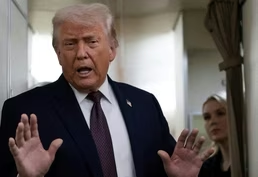
White House shifts response to Minn. shooting after outrage
Video has Closed Captions
Clip: 1/26/2026 | 3m 18s | White House shifts response to Minneapolis shooting after bipartisan outrage (3m 18s)
Providing Support for PBS.org
Learn Moreabout PBS online sponsorship
- News and Public Affairs

FRONTLINE is investigative journalism that questions, explains and changes our world.

- News and Public Affairs

Amanpour and Company features conversations with leaders and decision makers.











Support for PBS provided by:
Major corporate funding for the PBS News Hour is provided by BDO, BNSF, Consumer Cellular, American Cruise Lines, and Raymond James. Funding for the PBS NewsHour Weekend is provided by...